
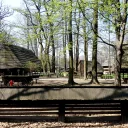
An open-air museum in Pszczyna with a dozen or so wooden examples of folk architecture of the Pszczyna land, opened in 1975 in the Pszczyna park.
The Pszczyna Village Farmstead (Zagroda Wsi Pszczyńskiej) is an open-air museum in Pszczyna that gathers examples of wooden folk architecture from the Pszczyna region. It was opened in 1975 in the eastern part of the historic Pszczyna park, on an area of about two hectares. A dozen or so buildings have been gathered here, from 18th-century granaries to a water mill, and the museum belongs to the Wooden Architecture Route of the Silesian Voivodeship.
The farmstead was opened through the efforts of the Society of Friends of the Pszczyna Land in the mid-1970s. The buildings were moved from surrounding villages in order to save the last evidence of traditional rural building. Since 2008 the museum has been managed by the Agency for the Development and Promotion of the Pszczyna Land. In 2013-2015, thanks to funds from the Regional Operational Programme of the Silesian Voivodeship and the municipality of Pszczyna, new buildings were put up: a multi-purpose building with a shop and a small workshop room, a wooden gazebo with a jetty over the pond, and an inn. A replica of a water mill with a mill wheel and a grain-grinding mechanism modelled on 18th-century solutions was also built.
The oldest monument is the manor granary from Czechowice, dating from 1784. Beside it stand an octagonal barn from Kryry from the 18th century, a dwelling cottage from Grzawa from 1831, a smithy from Goczałkowice from the 19th century and a water mill from Bojszowy, in which exhibition rooms have been arranged.
The collection also includes a small barn from Kobielice from 1811, a stable from Wisła Wielka from 1799, a granary from Rudołtowice from the 18th century, a gate shelter from Golasowice, a former church gate, cart sheds from Miedźna and Warszowice, a hay shed from Frydek, a mill with a windmill from Zebrzydowice from 1904, a well from Łąka, an apiary and a Neo-Gothic pillar shrine from Poręba. There is also a sculpture of the Utopiec (a water spirit of folklore) on the grounds.
In the cottages authentic furnishings have been gathered: agricultural and craft tools, ladder-sided wagons known as drabiniaki, freight sledges, carriages, furniture and examples of folk art. Most of the buildings have retained their original materials.
The open-air museum operates all year round. It runs educational workshops, among them “Secrets of the Bees” and “Mysteries of Herbs”, as well as art workshops. Folklore events take place on the grounds: Mały Brzym, Spotkania pod Brzymem, Stawianie moja (the raising of the May tree, the beginning of the folk spring), the Herb Festival and the Bee Festival. The museum also takes part in Museum Night and the European Heritage Days. It organises gatherings around feather stripping and embroidery, and re-enactments of Easter rites and the Christmas Eve supper convey the character of the old village.
The open-air museum lies within the Pszczyna park, about 700 metres from Pszczyna Castle, which makes it easy to visit both places in one day.
In the same park, about 1.4 kilometres from the open-air museum, is the Bison Show Enclosure. The museum's website announces a joint ticket for both sites.

Be the first! Add a comment.
You need to log in to add a comment.
Log in