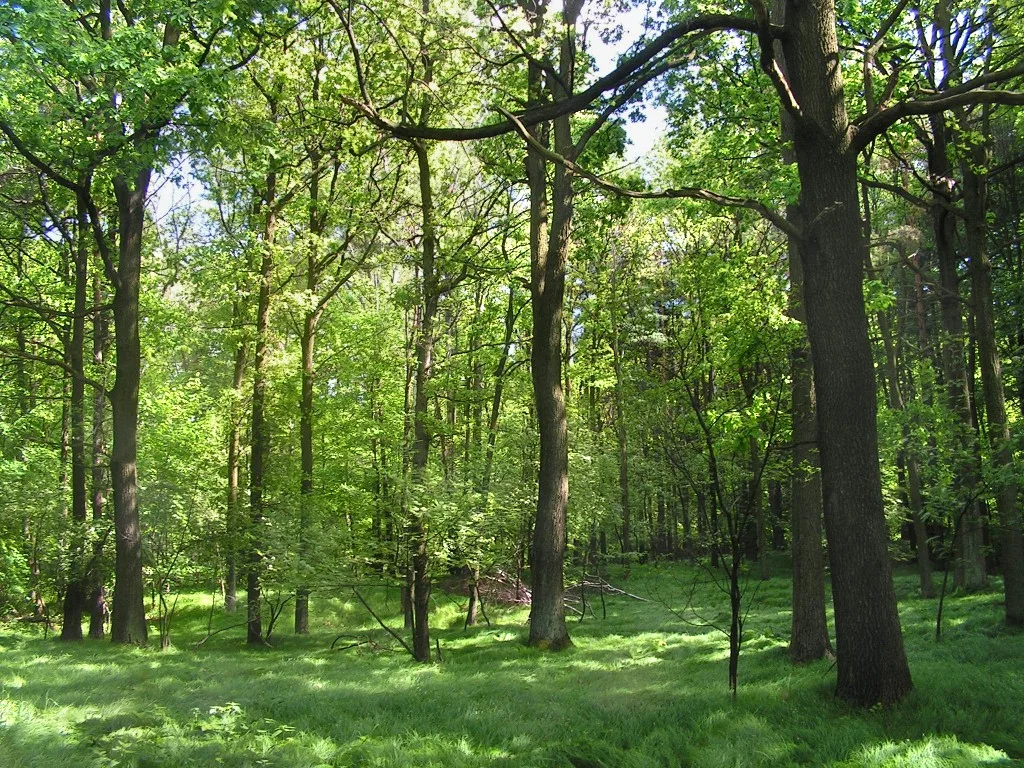
A forest nature reserve in Katowice-Murcki, protecting an old beech stand on the slopes of Wanda Hill and the sources of the Przyrwa stream.
The Las Murckowski nature reserve protects a remnant of the former Silesian Forest in Katowice, in the Murcki district. It is a mixed forest with natural features, lying right next to the conurbation, with an old beech stand on the slopes of Wanda Hill.
The reserve was established on 18 December 1953 on an area of 7.04 ha. In 1989 it was enlarged to 100.67 ha, and after a further enlargement in 2022 it covers 141.56 ha. The area is under active protection, and each fragment is surrounded by a protective zone, or buffer zone, with a total area of 256.06 ha.
The aim of protection is to preserve, for scientific, educational and social reasons, a fragment of mixed forest with natural features in the immediate vicinity of a city.
The reserve is formed by three separate fragments. The oldest, western one, covers 7.06 ha and borders the former “Murcki” mine and a road. It is separated from the second part, enlarged in 1989, by the four-lane expressway Katowice - Bielsko-Biała, that is Bielska Street.
The previous eastern part after the 2022 enlargement covers 119.78 ha. A new fragment of forest, extending furthest east, with an area of 14.72 ha, has also been added.
The terrain is varied: the reserve lies on the slopes of Wanda Hill (about 350 m above sea level), rippled by stream valleys. Within its area are the sources of the Przyrwa stream.
An old beech stand grows here, more than 150 years old, with numerous monumental specimens of beech and oak. Acidophilous lowland beech wood dominates. The understorey includes rowan, alder buckthorn, red-berried elder and common elder, and the herb layer includes wavy hair-grass, hairy wood-rush, narrow buckler-fern, May lily, wood sorrel and bilberry.
The vascular flora of the reserve comprises 210 species. Under strict protection are, among others, the snowdrop, the broad-leaved helleborine and the common twayblade, and under partial protection the asarabacca, sweet woodruff, lily of the valley, guelder rose, common ivy and lesser periwinkle.
Among the fungi there are protected species, such as the common stinkhorn and the giant polypore, associated with decaying beech wood. A study of bryophytes from 1995-1997 found 7 species of liverworts and 45 species of mosses.
The animals include the common toad, sand lizard, cuckoo, great spotted woodpecker, grey-headed woodpecker, robin, common shrew, northern white-breasted hedgehog, squirrel and weasel. There are 33 rare species covered by legal protection.
The history of bison breeding is linked with Murcki. The programme began here in 1865, and around 1891 the animals were moved to the Pszczyna forests.
The threat, especially to the part west of Bielska Street, is road traffic, neighbouring industrial and recreational areas, and the effects of underground coal mining. It is a forest in the middle of an industrial region and has to be treated as such.
In Murcki itself lies Murcki Park, and a little further on, in Giszowiec, Giszowiec Park. A historic workers’ housing estate and a post-industrial district can be combined with a visit to the reserve: Nikiszowiec is about 6.6 km as the crow flies.

Be the first! Add a comment.
You need to log in to add a comment.
Log in