
A workers' housing estate from the years 1908-1919 in Katowice, designed by Georg and Emil Zillmann, a Historic Monument since 2011.
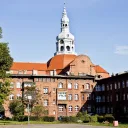
Nikiszowiec is a district of Katowice and a historic company housing estate, built in the years 1908-1919 by the Georg von Giesches Erben group for the miners of the "Giesche" mine, known since 1946 as "Wieczorek". The compact red-brick development is centred on Wyzwolenia Square and the neo-Baroque Church of St Anne.
When the group opened new shafts, there was a shortage of housing for workers. Permission to build a colony next to the "Nickisch" shaft was issued on 16 December 1908, and more than 20 ha were set aside for the estate. The name comes from the shaft, and the shaft took its name from a representative of the Giesche company, Baron Friedrich Nickisch von Rosenegk.
The design was made by the Berlin architects Georg and Emil Zillmann, who also designed the neighbouring Giszowiec. The first block was handed over in autumn 1911, six had been built by the outbreak of the First World War, and the last, ninth one was completed in 1919. The church was built from 1914, and the estate gained its present appearance in 1927, once construction was finished.
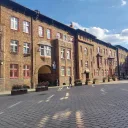
Unlike Giszowiec, with its houses in gardens, Nikiszowiec was planned as compact block development of an urban character. The housing consists of nine quarters of three-storey buildings, each designed for 165 flats. In total about a thousand flats were built, the typical one having two rooms with a kitchen and about 63 m².
Inside the quarters there are courtyards where pigsties and bread ovens, known as piekarnioki, once stood. They are entered from the street through vaulted passages, called ajnfarty, and the streets are closed off by bridging links resting on arcades. The raw brick façades are varied by arched lintels, oriel windows, portals, arcades and loggias. Above the entrance to the former post office at Wyzwolenia Square 4 there is a mosaic of red roses, referring to the Upper Silesian women's costume.
The centre of the estate is the elongated Wyzwolenia Square, with former shops in the arcades and the Church of St Anne. The church, also designed by the Zillmanns, was built on a Latin cross plan from raw brick, with stained glass by Georg Schneider of Regensburg and a historic organ by the Rieger brothers of Krnov.
At Rymarska Street 4, in a former laundry with a mangle, is the Department of Urban Ethnology, a branch of the Katowice History Museum. Its permanent exhibitions are "Woda i mydło najlepsze bielidło. W pralni i maglu na Nikiszowcu" (Water and soap, the best bleach: in the laundry and mangle room in Nikiszowiec), "U nos w doma na Nikiszu. We wnętrzu nikiszowieckiego mieszkania" (At home in Nikisz: inside a Nikiszowiec flat) and "Wokół mistrzów Grupy Janowskiej" (Around the masters of the Janów Group). In 1998 the private Wilson Shaft Gallery (Galeria Szyb Wilson) began operating in the buildings of the former checkroom of the "Wilson" shaft.
The urban layout of the estate was entered in the heritage register in 1978, and its buildings in 2013. By a regulation of the President of Poland of 14 January 2011, Nikiszowiec was declared a Historic Monument. Since 2006 it has been one of the points on the Industrial Monuments Route of the Silesian Voivodeship. About 2.2 km from the estate is the Rolling Mill - Zinc Metallurgy Museum.
The estate has left its mark on art: from 1946 it inspired non-professional artists of the Janów Group, while Kazimierz Kutz's film "Sól ziemi czarnej" (Salt of the Black Earth) tells of events from the time of the Silesian Uprisings, and "Perła w koronie" (The Pearl in the Crown) depicts the miners' strikes of the late 1930s.

Be the first! Add a comment.
You need to log in to add a comment.
Log in