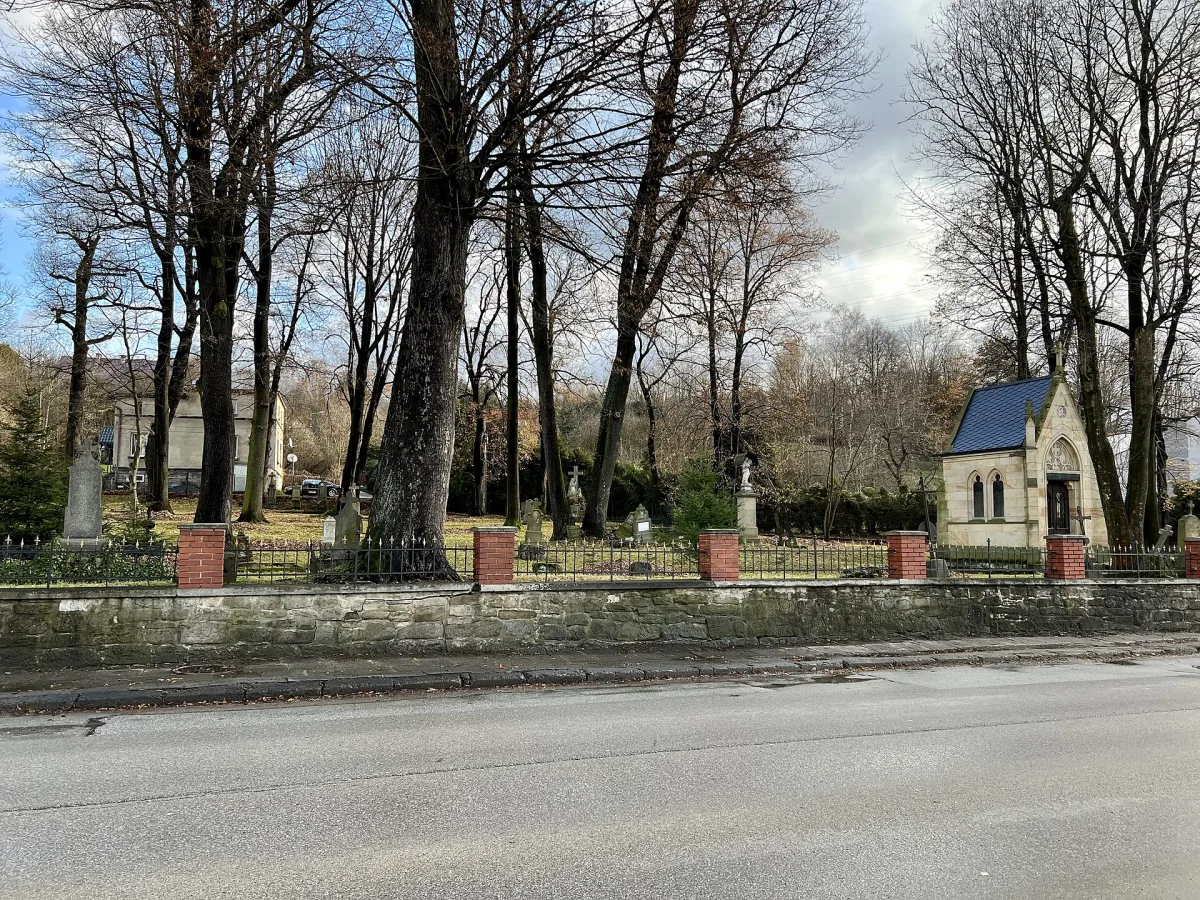
A historic cemetery from 1784 around the Church of St Mark, with a Neo-Gothic tomb chapel and cast-iron crosses.
The cemetery on Sienkiewicza Street in Żywiec was established in 1784 around the Church of St Mark. Today it is closed to new burials, and it is listed in the heritage register together with its gravestones, chapel and statue.
In 1584 a small shrine known as the Passion of the Lord was built on this site, and people who had died of plague began to be buried near it. In 1591 a wooden votive church was built here. After the plague subsided, St Mark's cemetery served for some time for the burial of the poor and people of lower status, and it lost this character at the beginning of the 19th century. At the end of the 18th century a paved road was built to it, in 1885 the wooden church was replaced with a brick one, and in 1905 the site was extended and fenced. The cemetery remains closed, and the last burial took place in 1957.
Many burghers of Żywiec are buried here, as well as people who did great service to the town and the county. Among them are Father Tomasz Czapela, parish priest in Ślemień, Wiktor Idziński, a doctor and one of the founders of the Żywiec hospital, and Władysław Nowotarski, headmaster of the boys' school and an activist of the Sokół society. A communal grave holds eight soldiers who died in 1892 during manoeuvres in Moszczanica, and in 1944-1945 several German soldiers were also buried here.
The most striking object is the Neo-Gothic tomb chapel of Father Czapela from 1907, built by the firm of Josef Leon Urban of Olomouc. It has a pointed-arch portal, gutters ending in dragon-shaped gargoyles and stained-glass windows. The cemetery is also decorated with cast-iron grave crosses and fences from the turn of the 19th and 20th centuries, cast mainly at the foundry in Węgierska Górka, and a late Baroque stone statue of St Joseph with the Child from 1797.

Be the first! Add a comment.
You need to log in to add a comment.
Log in