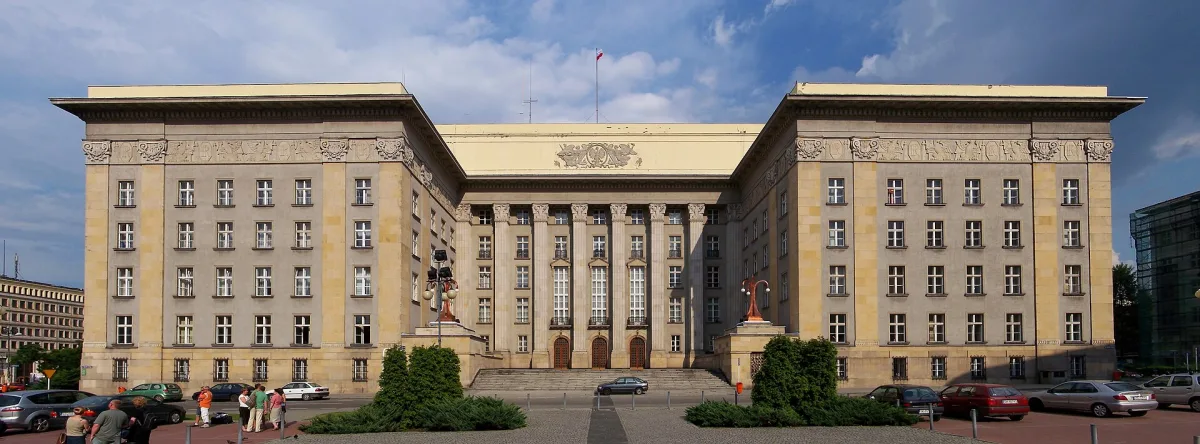
A neoclassical building from 1924-1929, the seat of the autonomous Silesian Sejm, a Monument of History, today the offices of the voivodeship.
The Silesian Parliament Building at ul. Jagiellońska 25 in Katowice is the largest administrative building by volume erected in interwar Poland and a Monument of History. It was built in 1924-1929 as the seat of the Voivodeship Office and the Silesian Sejm, a symbol of the autonomy of the Silesian Voivodeship. Today it houses the Marshal's Office, the Regional Assembly of the Silesian Voivodeship and the Silesian Voivodeship Office.
The Organic Statute granted the Silesian Voivodeship autonomy in 1920, and the first session of the Silesian Sejm took place on 10 October 1922. After the decision to build, a competition was announced and 67 entries were submitted. The winner was the design by the Kraków architects Kazimierz Wyczyński, Stefan Żeleński and Piotr Jurkiewicz. Construction began in spring 1924, and the building was consecrated on 5 May 1929 in the presence of President Ignacy Mościcki. Finishing work was fully completed in 1932. The building also temporarily housed the Silesian Museum. During the German occupation the building was taken over by the most important institutions of the Nazi authorities in Upper Silesia.
The mass is compact and symmetrical, with a four-wing body and projections at the corners, which give it a form resembling a palazzo in fortezza. The building is 92 metres wide and 106.5 metres long, and 31 metres high. The façades are given rhythm by great pilasters whose capitals are decorated with legionary eagles, and the projections bear the coats of arms of Upper Silesian towns, including Katowice, Bielsko, Rybnik, Cieszyn and Pszczyna. The style is neoclassical with decoration referring to Art Déco.
The vestibule with a double-flight staircase and a dome is decorated with the coats of arms of towns and with allegories: agricultural, industrial and insurgent Silesia, and Polonia Enthroned. The Sejm Chamber has an amphitheatre layout, a glass dome, and seats for the councillors of the regional assembly and for the public in the gallery. It was the first parliamentary chamber on Polish lands and served as a model for the extension of the Sejm building of the Republic of Poland in Warsaw. The Marble Hall, rebuilt during the war in the spirit of monumental Nazi architecture, served as a film set for the series “Stawka większa niż życie”. In the basement there is a vault in which the so-called Silesian Treasure was kept in the interwar period, as well as a shelter from the war.
It is about 400 metres to the Cathedral of Christ the King, and the Silesian Museum and the Stanisław Wyspiański Silesian Theatre lie about a kilometre away.

Be the first! Add a comment.
You need to log in to add a comment.
Log in