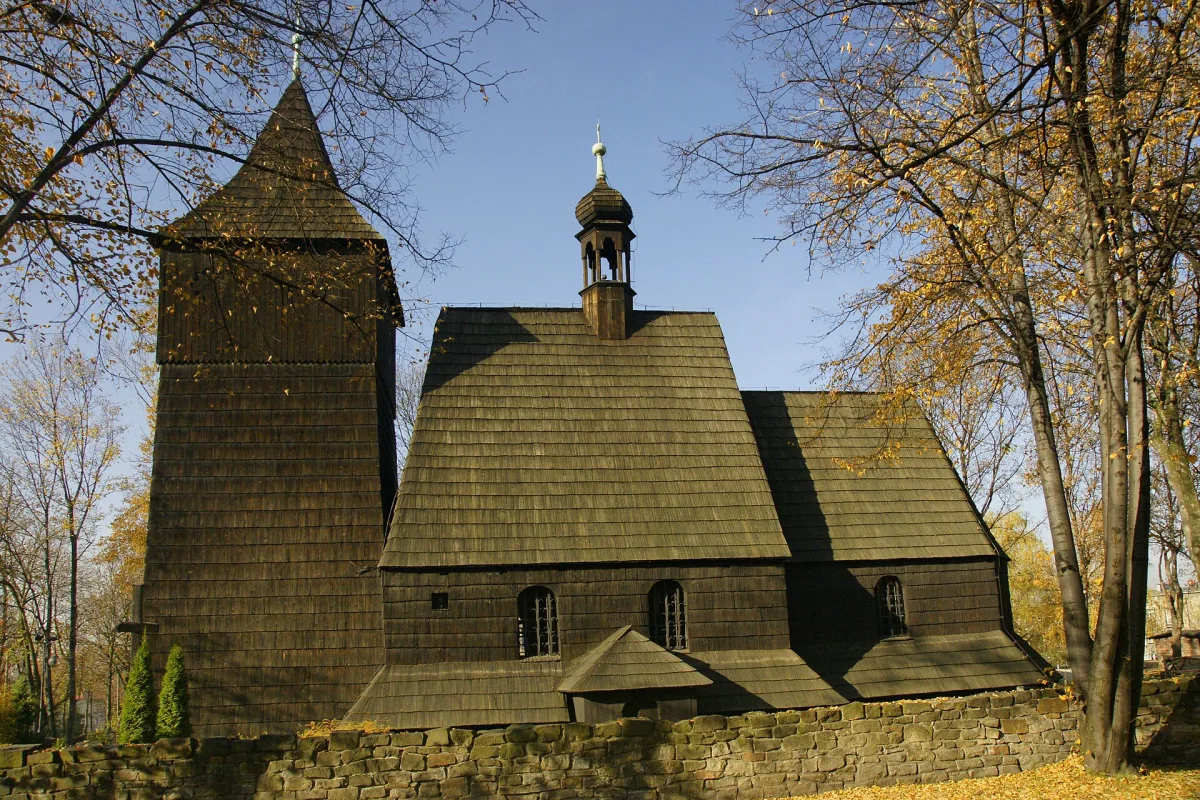
Wooden church of 1599, moved from Knurów to Chorzów in 1935-1938, on the Wooden Architecture Trail.
The wooden church of St Lawrence stands in Chorzów on Marii Konopnickiej Street, on Liberation Hill (Redena Hill). It was built in 1599 in Knurów, and in the 1930s it was dismantled and moved to Chorzów. It is entered in the heritage register and lies on the Wooden Architecture Trail of the Silesian Voivodeship.
The church served the parishioners of Knurów until it became too small for them. It was closed in 1926 in connection with plans for a new church and decayed for about ten years. On the initiative of the provincial conservator of monuments Tadeusz Dobrowolski, the church was dismantled and in 1935-1938 moved to Chorzów. The investor was the town authority, and the plot of 2,825 m² was donated by the Polish State Mines. Assembly on Liberation Hill began in 1936, and the building work was led by the architect Witold Czeczott Danielewicz. Bishop Stanisław Adamski consecrated the church on 16 October 1938.
The church was built of larch in log construction, and the tower is of post construction set on a log base. The nave has a plan close to a square, the chancel ends in three sides, the sacristy adjoins on the north-west and the porch on the south-east. The tower has sloping walls at the front and is covered with shingles, and its pyramidal spire is topped with a finial with a double-armed cross. Above the nave stands a hexagonal ridge turret with an onion dome. Shingled skirt roofs run around the church, and the grounds are enclosed by a stone wall.
The ceiling is decorated with polychrome painting by Stefan Kątski, modelled on the former patron-saint polychrome. The furnishings are mainly Baroque. The high altar has a marble altar table and a wooden, gilded retable with a 17th-century painting of St Lawrence. In the side altars hang 19th-century paintings of Our Lady of the Rosary and St Barbara, the work of the Wrocław painter Blady. In the church you can also see oil paintings from the 17th and 18th centuries, among them a Madonna and Child and St Agnes, and in the porch a stone holy-water stoup, probably from the 15th century.
A few hundred metres away lies the Upper Silesian Ethnographic Park, so the two visits are easy to combine. The Silesian Park is about two kilometres from here.

Be the first! Add a comment.
You need to log in to add a comment.
Log in