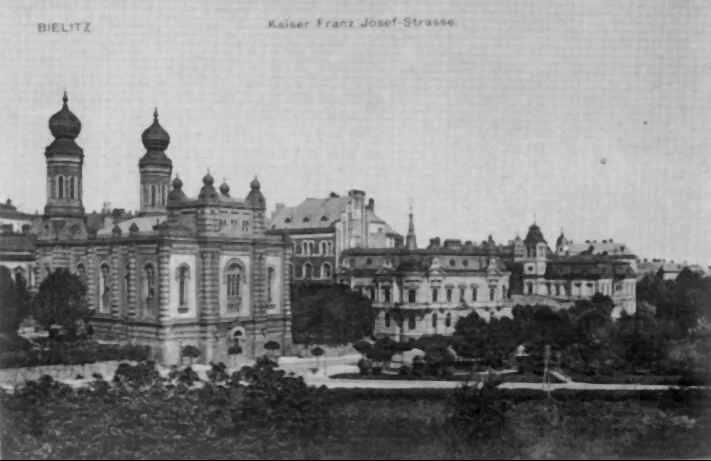
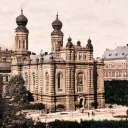
A no longer existing Neo-Moorish synagogue from 1879-1881, destroyed in 1939; on its site stands the Bielsko BWA Gallery with a commemorative plaque.
The synagogue in Bielsko no longer exists. It stood in the Lower Suburb (Dolne Przedmieście), between today's Mickiewicza and 3 Maja streets, and was destroyed on 13 September 1939. Today on its site stands the building of the Bielsko BWA Gallery with a plaque commemorating the former synagogue.
The Jewish community in Bielsko decided to build a new synagogue in March 1879. The building was erected in 1879-1881 to a design by Ludwig Schöne and Karl Korn, in the Neo-Moorish style with Neo-Romanesque accents. It was a copy of the synagogue in Szombathely in Hungary, designed a year earlier by Schöne. The ceremonial opening took place on 22 September 1881, and soon afterwards a dispute over authorship arose: the press named only Korn, while Schöne stressed that the plans, artistic details and cost estimate came from his Vienna office.
The building had an attic storey, numerous pinnacles with domes, Neo-Romanesque windows and two octagonal towers with spires. The main entrance was on the side of Mickiewicza Street, and the whole was surrounded by greenery.
The synagogue was completely destroyed in the first days of the Second World War. Only the foundations and part of the cellar survived. In the 1960s a modernist building was erected on the site, in which the Bielsko BWA Gallery was opened. In 1991 the Citizens' Committee set a commemorative plaque in the western wall of the building. In 2015 the Viennese architect-engineer Matthias Seitner prepared a virtual reconstruction of the synagogue, which was shown in the gallery itself in 2017.

Be the first! Add a comment.
You need to log in to add a comment.
Log in