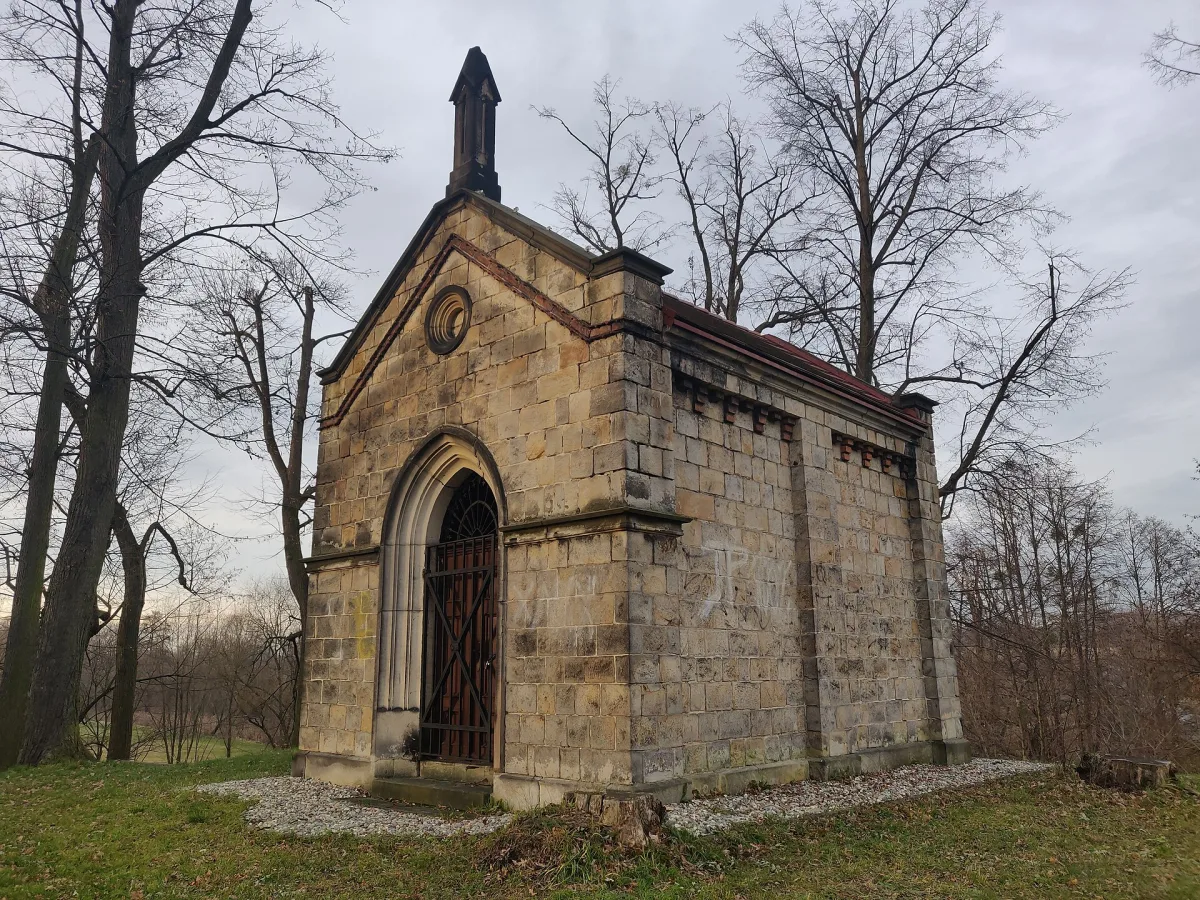
A Neo-Gothic chapel with the crypt of the Gemander family from 1859-1860, standing on a hill that is probably the remains of a medieval stronghold.
The Neo-Gothic chapel stands in Bełk on a low hill by Kościelna Street, in the Czerwionka-Leszczyny municipality. It was built as a tomb for the family of the owners of the local estate, and the hill on which it stands may be much older than the chapel itself. The site is entered in the heritage register together with the hill.
The chapel was built in 1859-1860 on the initiative of Antoni Gemander, then owner of the knightly estate in Bełk. The construction was led by the master mason Carl Wenzlik. The building is small, of stone (sandstone), built on a rectangular plan in the Neo-Gothic style. The façade is distinguished by a pointed-arch, profiled portal with a wooden door and a transom light.
The interior is a single space covered with a rib vault. The walls are decorated with paintings from the 1950s made by the local artist Józef Marek. Four scenes show the life and death of St John of Nepomuk: the interrogation before King Wenceslaus IV, the martyrdom and the death of the saint. Above the entrance, playing angels are painted, and the lower parts of the walls are covered with floral and geometric ornament. One of the scenes is illegible today because of the condition of the painting.
Beneath the chapel, partly dug into the hill, there is a crypt known as the Gemander Mausoleum, covered with a barrel vault. It has room for seven coffins. From the name of the family that founded the chapel and of another family linked with the place, the site bears the name of the tomb chapel of the Gemander and Lukas families.
The hill has the shape of a truncated cone, with a base diameter of about 35 m and a height of about 8 m. Traces of a former moat can be seen on it, and it lies on marshy ground, on the southern bank of the Bierawka river, which suggests a defensive function. It is believed to be the remains of a conical stronghold, the only such monument in Rybnik County. Other hypotheses link it with the seat of Bełk, the supposed founder of the village, or with the burial mound of Swedish soldiers from the Thirty Years' War.
In 2014 archaeological surface surveys and magnetic and electrical resistivity measurements were carried out here, which confirmed the probable location of the stronghold. The later chapel with its mausoleum made it impossible to find traces of a possible knightly residence. Numerous fragments of late medieval pottery were found, which went to the Upper Silesian Museum in Bytom. The chapel is surrounded by old trees, including small-leaved limes and pedunculate oaks.
Only 200 m away stands the Church of St Mary Magdalene in Bełk, so both sites are easy to see during one walk.

Be the first! Add a comment.
You need to log in to add a comment.
Log in