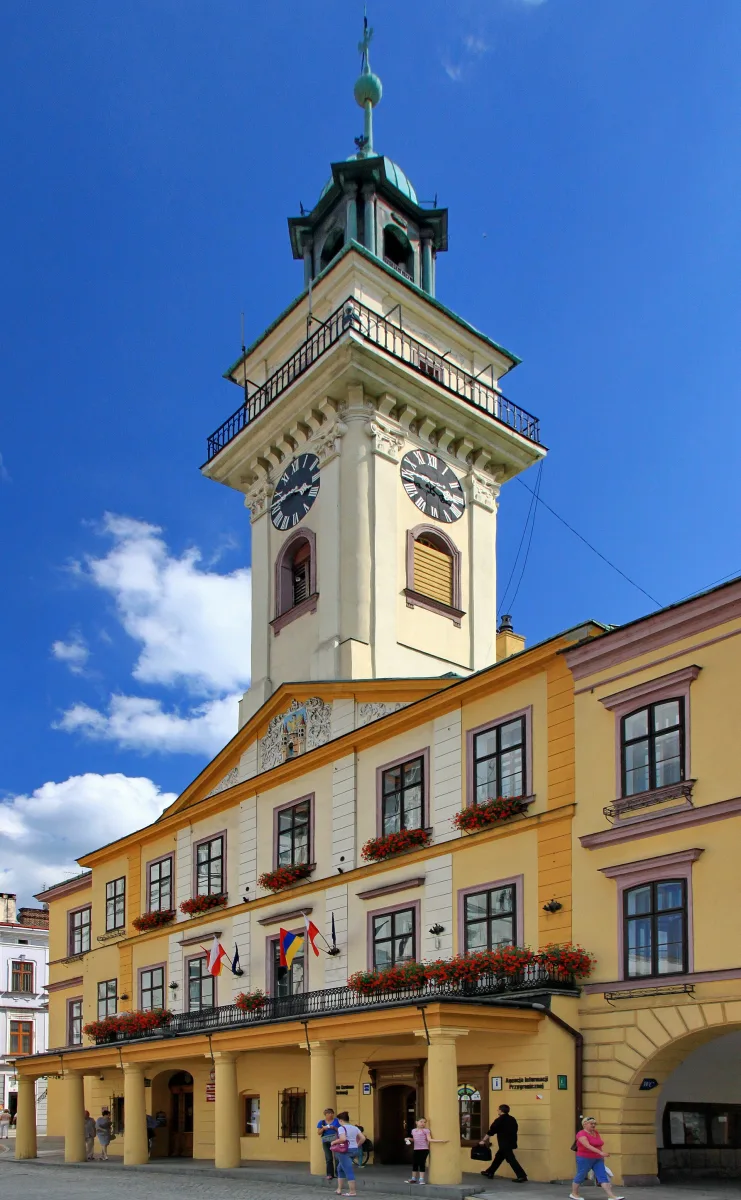
A Neoclassical town hall on Cieszyn Market Square with a clock tower, the seat of the town authorities, entered in the heritage register.
The Town Hall stands in the middle of Cieszyn's Market Square (Rynek) and to this day serves as the seat of the town authorities. The present building is Neoclassical and was built after a series of fires that over three centuries destroyed successive town halls on the same site. It is distinguished by its clock tower and a facade with a balcony supported on columns.
The first town hall on the Market Square was built in 1496, when Duke Casimir II sold his houses to the townspeople. On their site a building was erected with rooms for the shoemakers' and bakers' guilds and a tower with a clock. After a fire in 1552 the town hall was rebuilt in brick, with arcaded porticoes, a Renaissance parapet and a cylindrical tower with a spire.
In 1661 the facade was decorated with a sculpture of the Virgin Mary in a crown, imperial coats of arms and figures personifying the virtues. In 1726 the first theatre hall in the town was set up next to the town hall. Further fires, in 1720 and at the end of the 18th century, damaged the building so severely that it had to be built anew.
The new building, with Baroque-Neoclassical features, was designed by Ignacy Chambrez de Ryvos. The rebuilding was completed on 1 September 1800, with a crown and a sphere containing commemorative documents placed on the tower. After the fire of 1836 the town hall was rebuilt to designs by the architect Józef Kornhäusl, with a Neoclassical elevation and a Doric columned portico.
The building has three storeys, and the facade is accented by a six-bay projection with a balcony on six pillars, topped with a triangular pediment bearing the coat of arms of Cieszyn. The tower was built on a square plan with rounded corners and covered with a sheet-metal pavilion roof with a four-sided lantern. The clock mechanism from 1851 was made by Jan Chris Boeck of Austria, and the tower holds bells from the 18th century. Every day at noon a fanfare sounds from the tower, composed for the 1150th anniversary of the town's legendary founding.
In 1906 a meeting hall for the town council was added to the town hall, opened on 2 September that year during a visit by the emperor. The hall has preserved its Art Nouveau stoves and a frieze of coats of arms with 24 guild emblems. Since 2014 the council chamber has sometimes been made available for wedding ceremonies.

Be the first! Add a comment.
You need to log in to add a comment.
Log in