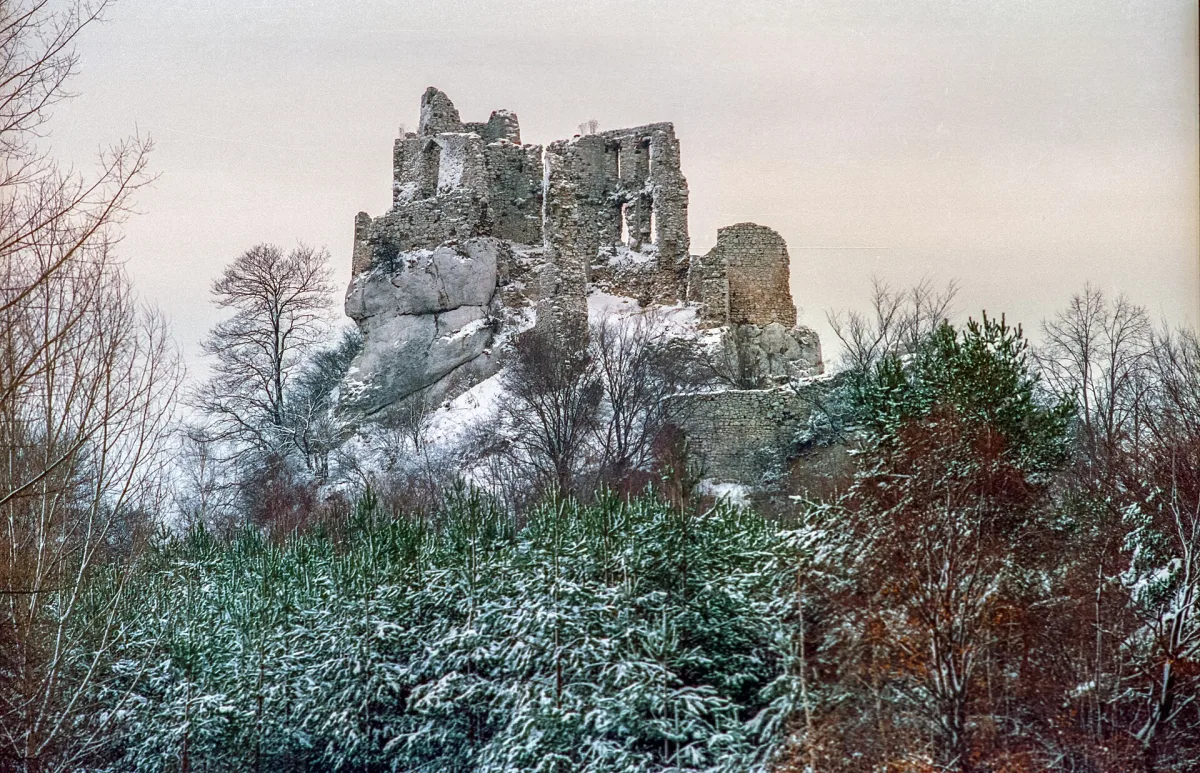
A castle from the mid-14th century on a limestone hill in the municipality of Niegowa, rebuilt from ruins and opened in 2011, on the Trail of the Eagles' Nests.
Bobolice Castle is a stronghold on a rocky hill 360 m above sea level in the Kraków-Częstochowa Upland, in Myszków County, in the municipality of Niegowa. It was built in the mid-14th century on the orders of Casimir the Great, as part of the defensive system of the Eagles' Nests. Today's castle was rebuilt from a ruin at the beginning of the 21st century and opened to tourists in September 2011.
The documents do not give an exact date of construction. On the basis of an analysis of events in the life of Casimir the Great, it has been established that the castle was built in 1350-1352. Limestone outcrops were used in the construction, and the building was adapted to the shape of the terrain. The defensive elements were two semicircular towers.
In 1370 Louis of Hungary granted the castle to Władysław, Duke of Opole. In 1379 it passed to Andrew Schona de Barlabas, known as Andrew the Hungarian, who later styled himself "of Bobolice". In the 15th century the castle belonged in turn to the Szafraniec and Treska families, and from 1486 to the Krezas. Around 1560 it was rebuilt as a Renaissance family residence.
In December 1587 the pretender to the Polish throne, Archduke Maximilian III of Habsburg, occupied the castle, which was surrendered to him without a fight, and in January 1588 it was retaken by the troops of Jan Zamoyski. In the 17th century the Fogelweder family gave the building a form with a main tower and stone stairs, which survived until the early 19th century.
The ruins were entered in the heritage register on 8 February 1961. In 1996 private investors bought the ruins in order to secure them. Studies showed that the only way to save the castle was to recreate its appearance from its heyday. Reconstruction began in 2001 after consultations with the Polish scholarly community, and archaeology lasted three years. The mortar was made with, among other things, washed river sand and slaked lime that had been left to mature in pits for 30 years.
In 2010 the rock gate at the foot of the castle was unveiled. The whole reconstruction took 10 years, and the castle was opened on 3 September 2011. The reconstruction was controversial: some specialists charged that there were no sources on the castle's former appearance, and the oldest surviving iconographic records concern only the ruin from the 18th century. Supporters stressed the backing of the scholarly community, and the work was carried out on the basis of the required permits and decisions of the heritage conservator.
The present-day castle is a two-storey residential building with a tower, corresponding largely to its 17th-century form. It is surrounded by a crenellated wall of white limestone, and the roof is covered with wooden shingles. A drawbridge over a dry moat leads to the interior. The southern part has not been reconstructed and has a secondary roof, because there was no basis for recreating the entrance loggia.
The castle is linked with the legend of the brothers Bobol and Mir, owners of the castles in Bobolice and Mirów. It tells of an underground tunnel with hidden treasure and of the ghost of the White Lady. This is a folk tale, not a historical fact. The castle appeared in Andrzej Wajda's 2016 film "Afterimage" ("Powidoki") and in the series "Korona królów".

Be the first! Add a comment.
You need to log in to add a comment.
Log in