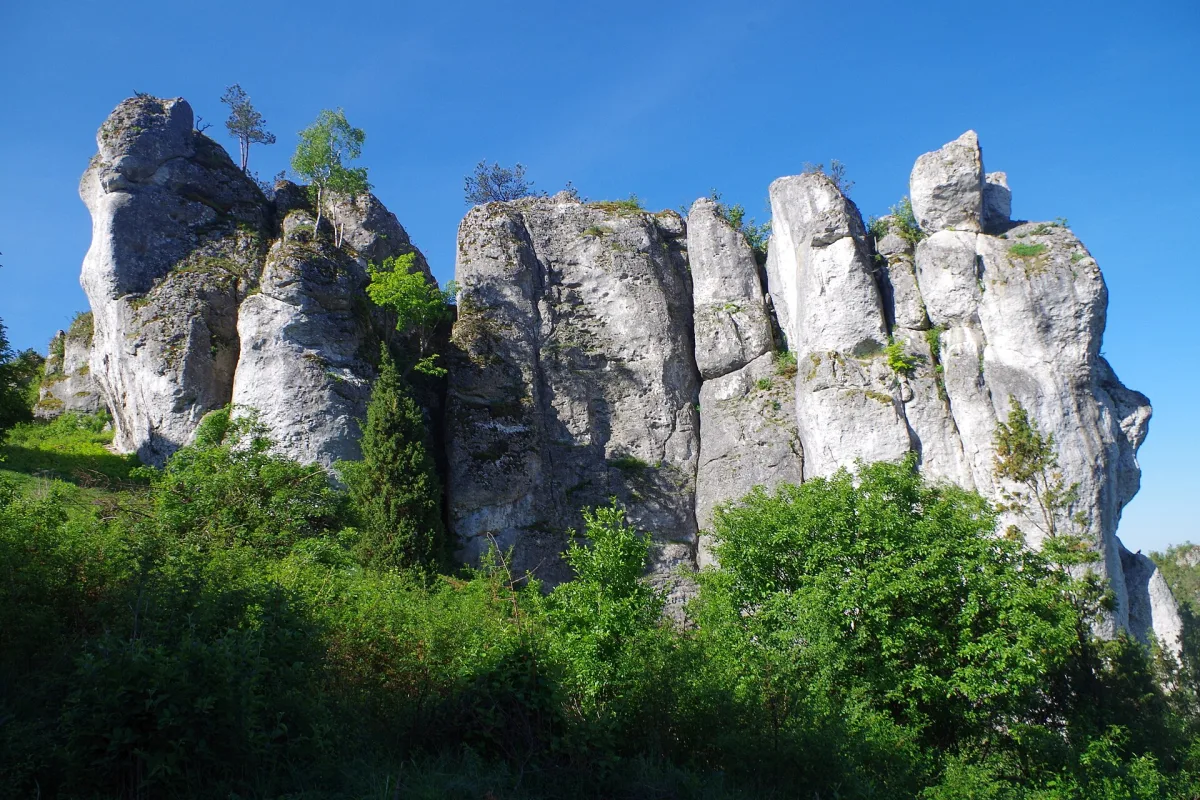
A group of limestone rocks 5-30 m high on the ridge between the castles in Mirów and Bobolice, along the Trail of the Eagles' Nests.
The Mirów Rocks are a group of limestone rocks on the ridge of a rise, from the castle in Mirów to Bobolice, in Myszków County. They form part of the Mirów-Bobolice Ridge, also known as the Mirów Range. They stretch for over a kilometre along the Trail of the Eagles' Nests, and a wide panorama opens from the trail, which often leads over the tops of the rocks.
The rocks are 5 to 30 metres high and are made of hard Jurassic limestone. The surroundings are grassy, and xerothermic vegetation grows on the rocks. Climbers have divided them into groups and named the individual crags: from the west these are the Rocks by the Castle (including Grzyb), the Three Sisters Group, Krótka Grzęda, Szeroka Baszta and Mniszek, the Kukuczka Crag Group and the Rock with a Cave Group. Nearby lie Mirów Castle and Bobolice Castle.
The rocks are a popular rock-climbing destination: about 150 routes have been set on them, of grades II to VI on the Kurtyka scale, and most face north. A turning point was the competition on the Kukuczka Crag in 1989, and rapid development of climbing came in the 1990s. Research has shown that climbing has a significant negative effect on rock vegetation, which is why control of this form of tourism is called for.
The rocks contain rock shelters and caves. The longest, Sucha Cave, is 75 m long and is described as dangerous. In the Stajnia cave archaeologists found fragments of Neanderthal remains in the sediment, according to the sources the only ones in Poland.

Be the first! Add a comment.
You need to log in to add a comment.
Log in