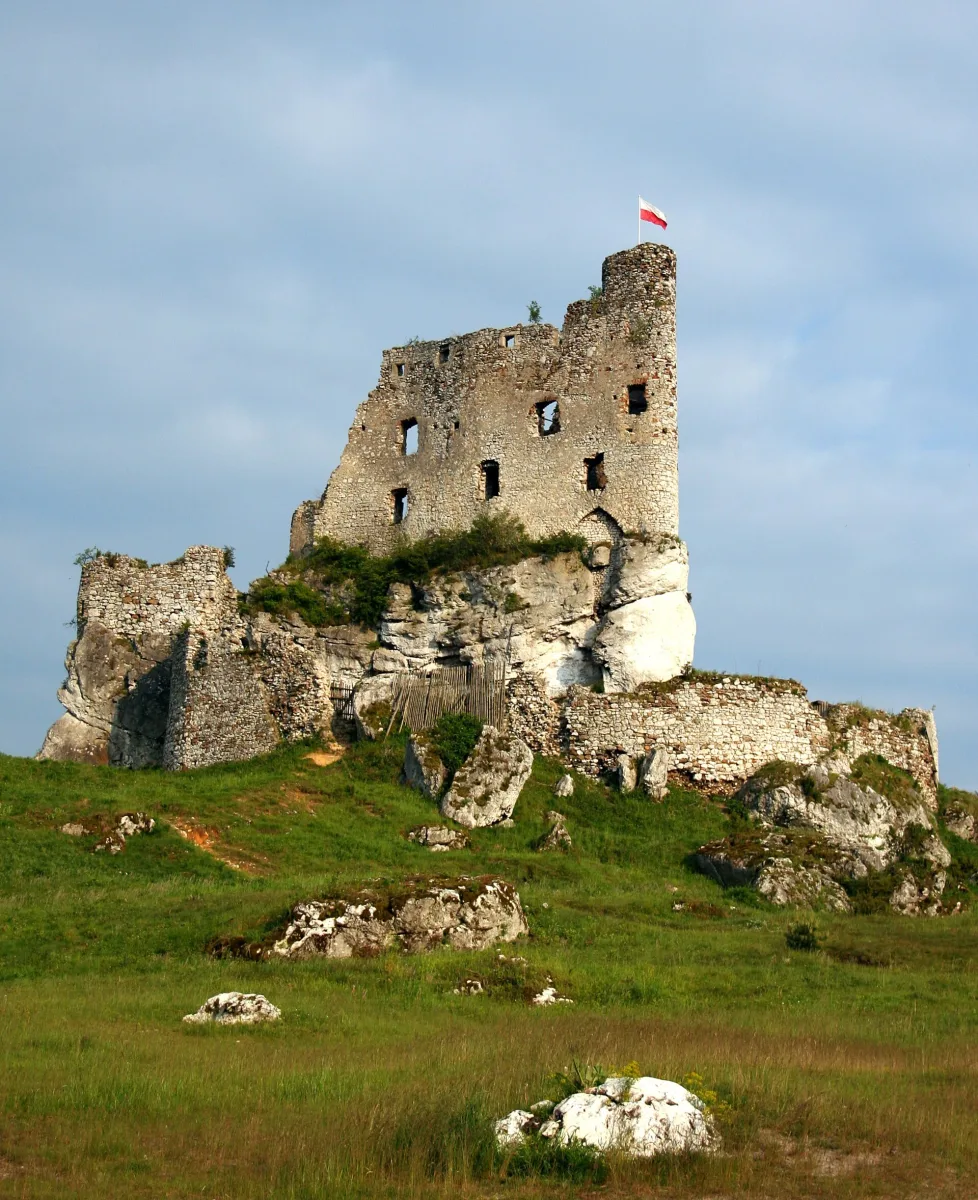
The ruins of a 14th-century Gothic castle in the Kraków-Częstochowa Upland, part of the system of the Eagles' Nests, entered in the heritage register.
Mirów Castle is the ruin of a medieval stronghold in the Kraków-Częstochowa Upland, in the municipality of Niegowa in Myszków County. It was built around the middle of the 14th century under Casimir the Great, and is part of the defensive system known as the Eagles' Nests. The walls were incorporated into the natural limestone rocks, and it is about 1.3 km from the nearby Bobolice Castle.
The castle was built around the middle of the 14th century next to the village of Mirów, and sources mention earlier timber and earth structures.
At first there stood a stone watchtower here, subordinate to the nearby castle in Bobolice. It belonged to the Lis family, who initiated the extension of the fortifications into the form of a knightly castle. In 1378 Louis of Hungary granted the stronghold to Władysław of Opole, but Władysław Jagiełło took it away in 1396. In 1489 the castle was acquired by the Myszkowski family of the Jastrzębiec coat of arms, who raised it and added a residential tower. Later it belonged to the Koryciński and Męciński families.
It suffered seriously during the Swedish Deluge, and in 1787 it was abandoned. The inhabitants began to take the walls apart for building material. In the 19th century the castle, by then without roofs, was inventoried for the first time, and in 1934 its southern wall collapsed.
From the beginning the castle had an upper and a lower part, separated by walls linking the natural limestone rocks.
The layout with several courtyards, each with its own gate, has survived. The area of the castle grew from the original approximately 270 m² to 1,200 m² after the extensions. The heritage register describes the complex as an upper and lower castle surrounded by defensive walls, ramparts and moats, with two residential towers, gate towers and stone late Gothic and Renaissance portals of the 15th and 16th centuries. The upper castle has a characteristic tower whose lower part is triangular and upper part elliptical. Researchers distinguish four building phases, from the 14th to the 17th century. Originally it was a military defensive point, and only in the 15th century was it adapted for living.
The castle is entered in the heritage register, and the ruins are in poor condition, so visiting is limited.
According to the zabytek.pl service, access has been restricted because of the poor condition of the walls and ongoing securing work, and the site is viewed from the outside. Since 2025 it has been possible to visit the inner courtyard with its cloister walks. The rules for visiting change, so check them before you travel. Securing work has been carried out by a private owner since 2006. Part of the film "By the River That Does Not Exist" ("Nad rzeką, której nie ma"), directed by Andrzej Barański in 1991, was shot at the castle.
The ruins neighbour rock formations, caves and other castles of the Trail of the Eagles' Nests. The nearest destination is the Mirów Rocks, about half a kilometre away, and further on the Eagles' Nests Landscape Park.

Be the first! Add a comment.
You need to log in to add a comment.
Log in