
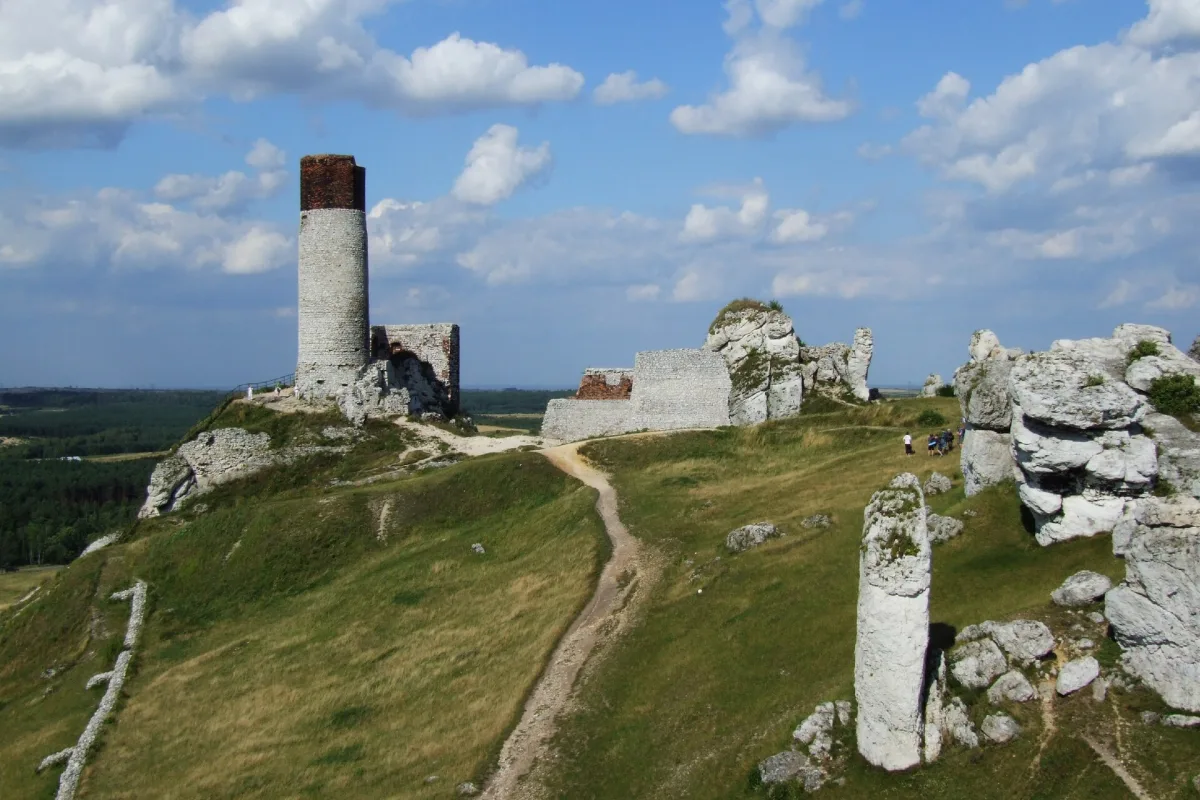
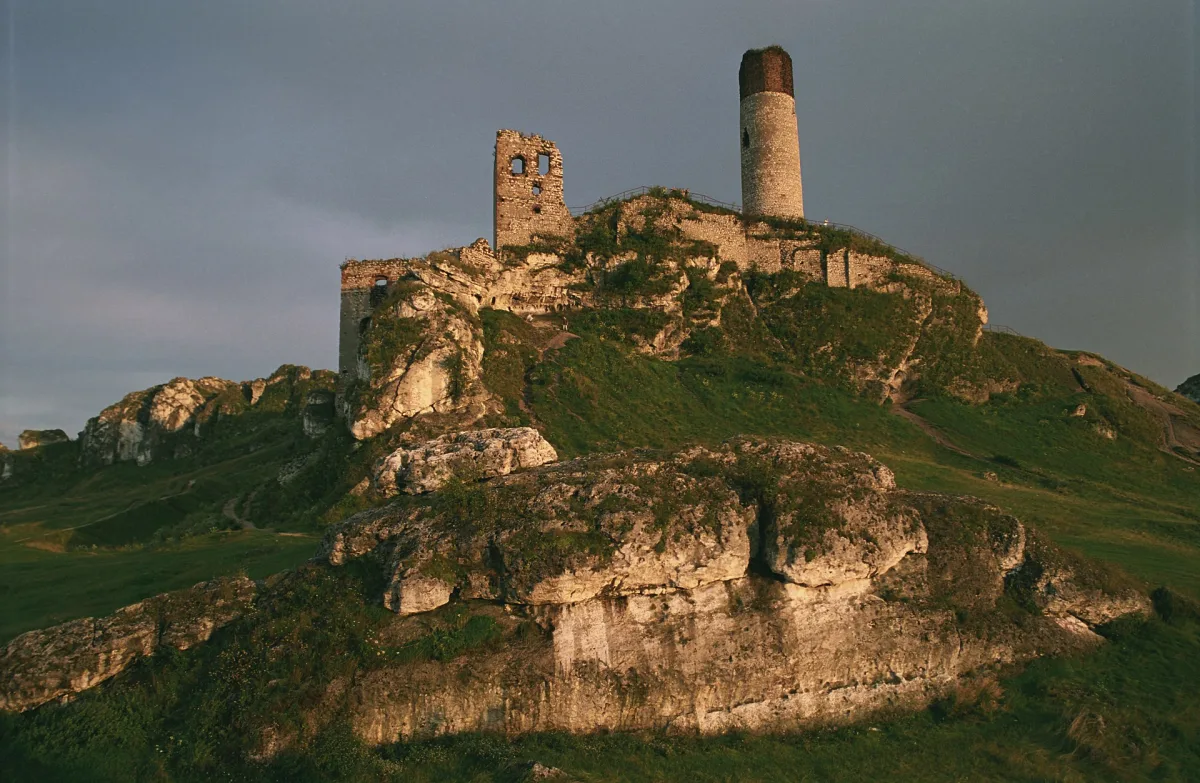
The castle in Olsztyn near Częstochowa has in its history both sieges and a find from forty thousand years ago. Today what remains are ruins on a rock, with a cylindrical keep and the square Starost's Tower, but beneath and beside them archaeologists are still uncovering things that were unknown just over a decade ago.
From a watchtower to a royal castle
The first mention of the castle dates from 1306. It was then still called the castle in Przemiłowice, and it appears in the records of the second trial of the Bishop of Kraków, Jan Muskata, brought against him by Archbishop Jakub Świnka of Gniezno. The records themselves concern events of 1294, so the castle existed earlier. Research in 2010 confirmed its 13th-century origin. The heritage register dates the site to the 14th century.
In the 14th century the watchtower was expanded by Casimir the Great, creating one of the most strongly fortified castles on the Silesian-Lesser Poland border. In 1370 King Louis of Hungary gave Olsztyn as a fief to Władysław of Opole. Already in 1391, after a week-long siege, the castle was taken on the orders of Władysław Jagiełło by Spytek of Melsztyn, who restored it to the Crown. In 1406 the settlement below the castle became the seat of a starostwo (royal administrative district), and in 1488 Casimir IV Jagiellon granted it town rights. In the 15th century the lower castle was built, and in 1545 Sigismund Augustus was a guest there.
The siege of 1587
In 1587 the castle was attacked by the Austrian troops of Archduke Maximilian of Habsburg, a pretender to the Polish throne. The defence was commanded by the starost Kasper Karliński. According to tradition, the starost's kidnapped son, a child of a few years, was placed with his nurse in front of the castle in the front line of fire. The defence succeeded, but at the cost of the child's life. The castle was badly damaged. The event was described by Władysław Syrokomla and by Aleksander Fredro, who wrote the play “The Defence of Olsztyn”.
The rebuilding was led by the starost Joachim Ocieski, but after his death the castle fell into ruin. The starost Mikołaj Wolski, in office from 1613, concentrated on maintaining the residence in Krzepice. A survey of 1631 found the site badly damaged.
The Swedes, the church and peasants with shovels
In October 1655 part of the Swedish army marching on Częstochowa attacked Olsztyn. After a short siege the castle was taken and ruined, and the town burned. Here the sources do not agree: some sources attribute the destruction to the Swedes, while a 2019 dispatch of Nauka w Polsce says that the castle had fallen into ruin even before the Swedish Deluge. Both statements may describe the same process, because the survey of 1631 had already found the castle in a ruined state.
After the war the castle was unusable. The royal fortification engineer Krzysztof Mieroszewski still carried out some work, but its effect was small, and rebuilding was abandoned because of the cost. Castles of the old type were then losing their defensive value against artillery. During the construction of the parish church in 1722-1726 large parts of the lower sections of the castle were pulled down, and in the 19th century peasants gradually took stone from the walls for building material. The Olsztyn starostwo survived until the end of the 18th century.
What stands today
What survives are the walls of the residential part, the cylindrical tower (the keep), the square tower known as the Starost's Tower, fragments of the walls of outbuildings, partly the cellars, and the foundations of a forge together with traces of bloomery furnaces. Since 1964 the ruins have belonged to the Land Community in Olsztyn. A description of the castle in Olsztyn is on its entry, and on the market square, a few hundred metres away, there is a display case with a 1:100 scale model of the castle, described under the market square in Olsztyn.
According to tradition, the castle held the Voivode of Poznań, Maciek Borkowic, who was sentenced to death by starvation for a plot against the king. The legend says his ghost still haunts the place with the clanking of chains. It is a legend and, like other stories of this kind from the castles of the Jura, it is described in a separate article on the ghosts and treasures of the Jura castles.
Neanderthals in the cave below the castle
In 2015 archaeologists surveyed the area of the lower castle and established the position of three piers of the bridge leading from the gate tower to the upper castle, and of the gate tower itself. The real turn came, however, in July 2019. A team led by the archaeologist Dr Mikołaj Urbanowski of the Przyroda i Człowiek Foundation, working in a spacious cave on the grounds of the lower castle, found there more than 200 flint tools made by Neanderthals. According to the PAP agency on 5 August 2019 they are about 40,000 years old. Among them are knives and scrapers, including a bifacially worked knife in Levallois technology. The research was originally part of a project to partly reconstruct the castle and was only meant to tidy up the cave after earlier, limited investigations decades ago.
The cave also has a later history. In the 15th century a metallurgical furnace stood in it, in which bronze was smelted. Next to it were found several kilograms of production waste. Beneath the furnace lay the skeleton of a young dog, which the researcher considered a probable foundation sacrifice, connected with the superstitions of metalworkers. The archaeologist stresses that placing a furnace in a cave is an oddity at least on the scale of Poland. In the 16th and 17th centuries the cave was a pantry, as shown by surviving texts mentioning barrels of salted pork, sauerkraut and saffron milk caps.
In July 2020 a PAP announcement stated that just next to it, in the vestibule of the well tower, another large cave and a system of tunnels and crevices had been discovered. Found there, among other things, was a decorated stove tile with a mounted falconer knight from the second half of the 15th century or the beginning of the 16th. Work is still continuing, so nothing has yet been said about the age of all the layers.
Be the first! Add a comment.
You need to log in to add a comment.
Log in