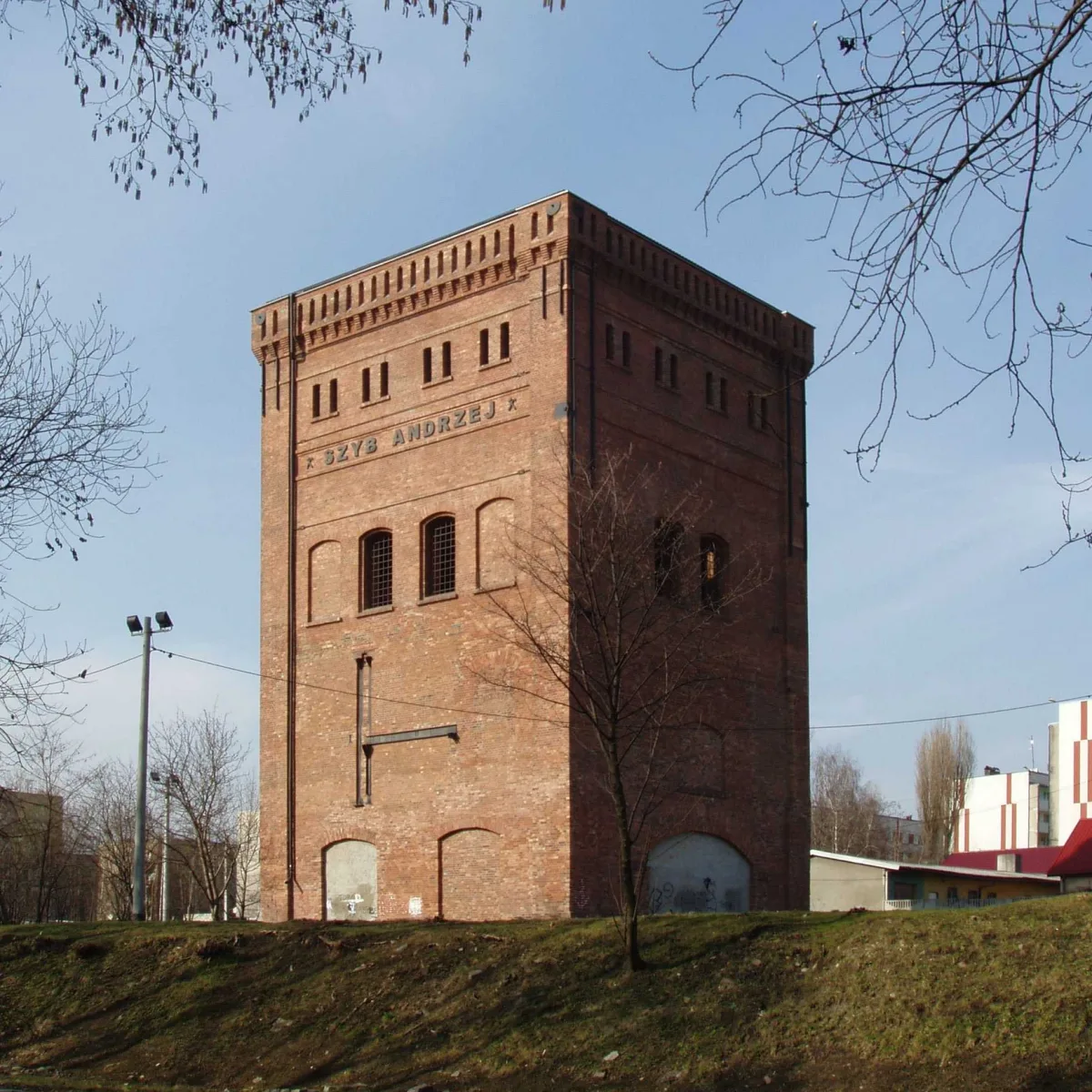
The brick headframe building of the Andrzej shaft in Ruda Śląska is a four-storey tower of the Malakoff tower type, a monument of a former mine.
The Andrzej Shaft Tower is the brick headframe building of the former Gottessegen hard coal mine, later called Błogosławieństwo Boże (God's Blessing). Until 1922 the shaft bore the German name Aschenborn, after the mine director Adolf Aschenborn. It is listed in the heritage register.
Sinking began around 1870. The shaft reached 365.25 m and gave access to seams 402-411. Originally it was a downcast, hoisting and materials shaft, with two cages driven by steam engines, and later it received an electric winding engine. In the 20th century it served auxiliary functions, including draining the workings. After 1945 the Wanda-Lech mine took it over, and small amounts of coal were extracted until 1969. The winding equipment was dismantled in 1969, the shaft was backfilled in 1976, and in 1994 the remaining buildings of the complex, including the engine house and warehouses, were demolished. From 2002 the revitalisation of the headframe building was under way, including the reconstruction of the roof and renovation of the façades.
The brick building stands on a square plan with sides of 14 m and is 23.4 m high, about 28 m including the roof. The walls are 1.30 m thick at the base. The four-sided mass resembles a medieval defensive tower: a ground floor, a first floor with large windows and an attic with small windows and crenellation. The rope pulleys, 4225 mm in diameter, were located at heights of 18 and 21 m.

Be the first! Add a comment.
You need to log in to add a comment.
Log in