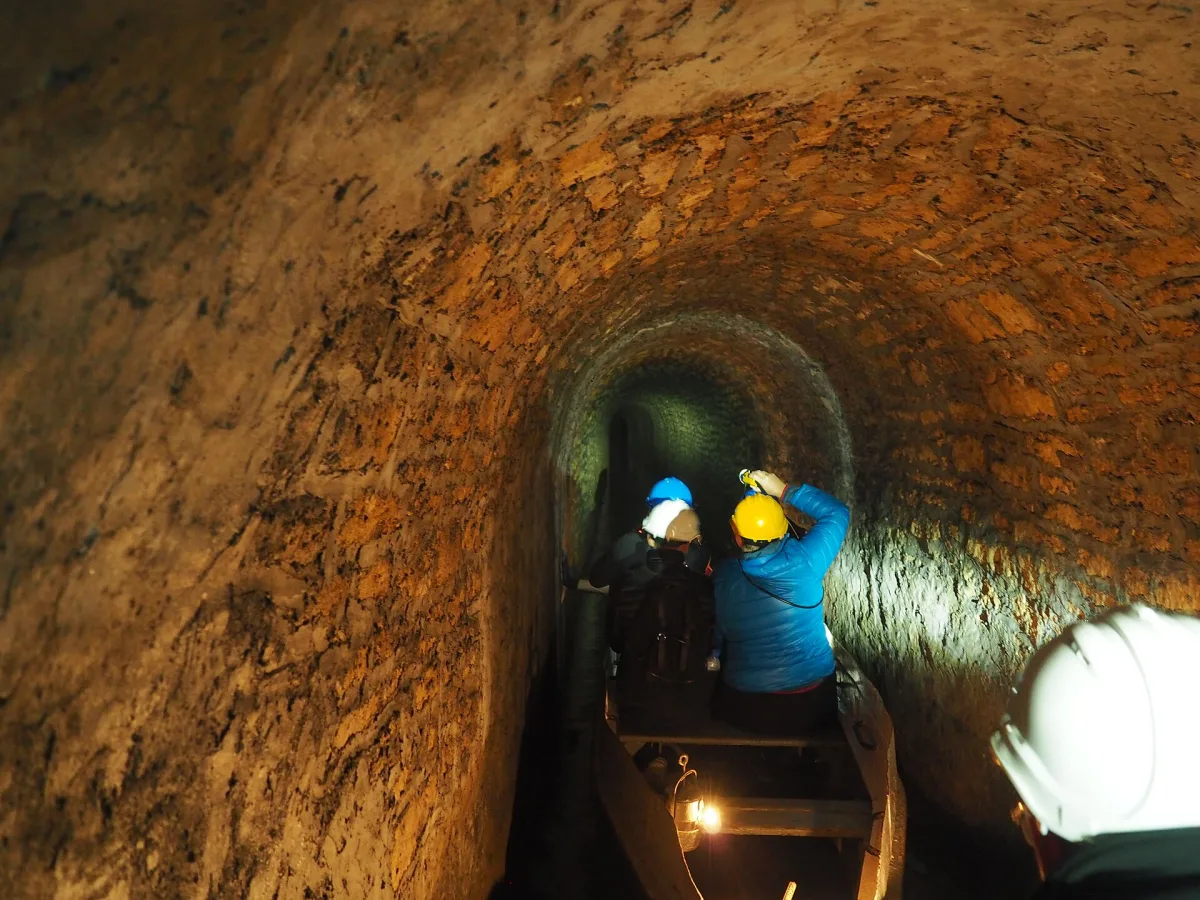
An underground boat trip along a 600-metre section of a 19th-century drainage adit, part of a UNESCO-listed site.
The Black Trout Adit in Ptakowice near Tarnowskie Góry is a 600-metre section of the Fryderyk Deep Adit, a former drainage tunnel of a lead and silver ore mine. It is visited by boat, several dozen metres underground.
The adit was driven to drain water from the workings of the royal Fryderyk mine, founded in 1784. The existing horse gins were not enough, so in 1820 a design for a new drainage adit, prepared by the mining masters Thürnagel and Eisleben, was approved.
Work began on 21 April 1821 in Ptakowice. The tunnel, 4,568 metres long, was driven simultaneously from 14 faces, reached through small shafts sunk along the line of the adit. Along the route 25 ventilation shafts were sunk, and the existing Adolph shaft was deepened.
Progress was 3-4 metres a week. The adit was put into use on 15 July 1834, at a ceremony combined with the 50th anniversary of the mine. The outlet of the underground part was framed in a Neoclassical sandstone portal, and after a 889-metre channel the waters of the adit flow into the Drama river.
Visiting the adit has been possible since 1957 and feels like a cruise underground. The route runs between the Ewa and Sylwester shafts. After going down a winding staircase to an underground landing stage, you board a boat and travel 600 metres by lamplight.
The guide pushes the boat off the walls and tells the story of Tarnowskie Góry mining. The adit lies at a depth of 20-30 metres, is 1.2 to 2.5 metres wide and up to 4 metres high, and the water is 0.7 to 1 metre deep. On the route you can see small stalactites forming today and original sections of the tunnel cut into dolomite.
By the Sylwester shaft stands a visitor base opened in 2020, with a visitor service centre, a souvenir shop, an educational room and a viewing terrace over the Drama valley.
The Black Trout Adit, together with the underground workings of the Silver Mine in Tarnowskie Góry, was declared a Historic Monument by regulation of the President of Poland of 14 April 2004. It also belongs to the Industrial Monuments Route of the Silesian Voivodeship.
Together with the Silver Mine in Tarnowskie Góry and other post-mining sites, it was inscribed on the UNESCO World Heritage List at the session of the World Heritage Committee on 9 July 2017. Next to it you can see the Silver Mine in Tarnowskie Góry, and the Royal Fryderyk Mine is also nearby.

Be the first! Add a comment.
You need to log in to add a comment.
Log in