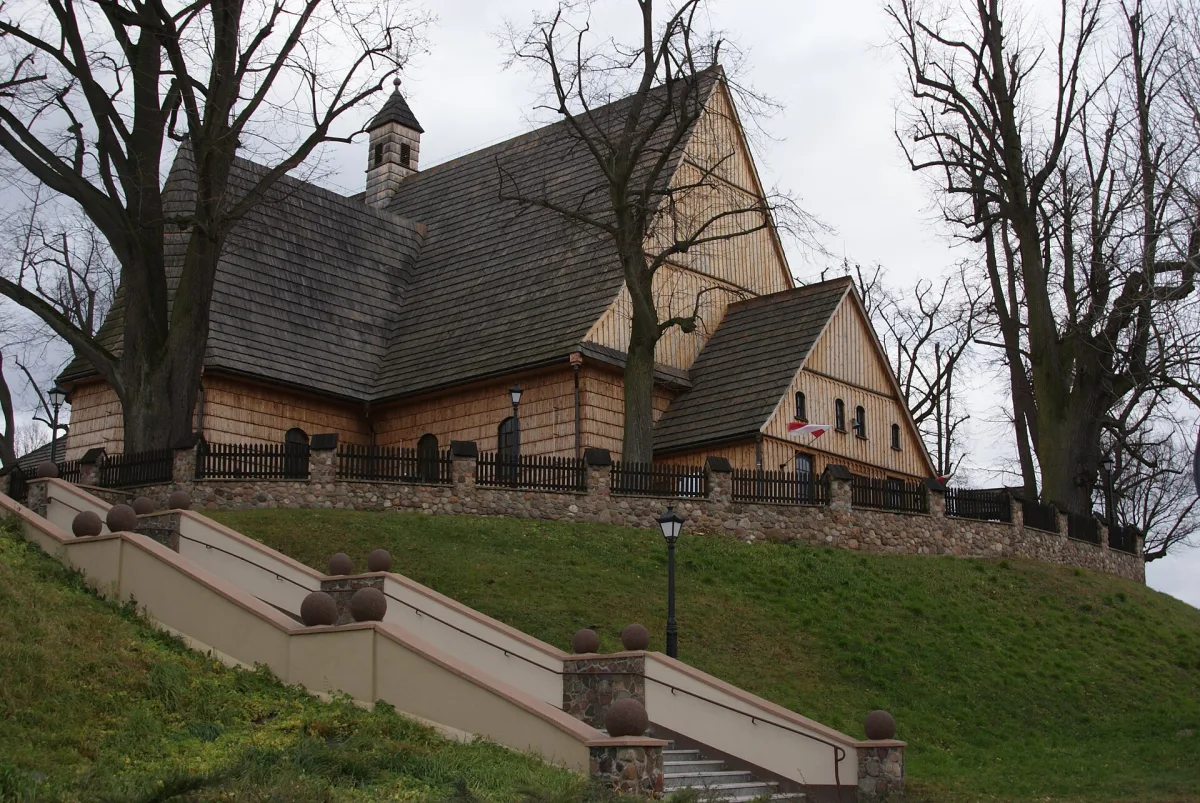
A wooden Baroque church from 1737, the shrine of Our Lady of Truskolasy, on the Wooden Architecture Trail of the Silesian Voivodeship.
The Church of St Nicholas in Truskolasy is a wooden parish church from 1737 and at the same time the shrine of Our Lady of Truskolasy. It stands on a hill in the municipality of Wręczyca Wielka, in Kłobuck County, in the Archdiocese of Częstochowa, and belongs to the Wooden Architecture Trail of the Silesian Voivodeship.
The church was built by Józef Winner, a leaseholder of the Krzepice starostwo, in 1737, and the consecration took place on 26 November 1746. The previous church was pulled down in 1736. Until 1810 the church belonged to the parish of St Martin in Kłobuck.
The building was renovated several times. In 1835 the leaning towers were lowered, and after a gale in 1877 that badly damaged one of them, it was decided to dismantle them. In 1881 the walls were clad in boards. In 2006-2007 a thorough renovation was carried out in which the shingles on the roof and walls were restored. In 2009 the church received the laurel of the Well-Kept Monument (Zabytek Zadbany) competition.
The church is wooden, of log construction, in the Baroque style, with an elongated chancel closed on three sides. The nave has two narrow side aisles and a wide central one, and on the sides two chapels: of Our Lady of the Scapular and of St Joseph. Above the nave rises a turret for a sanctus bell with a tent roof, and the vault is a false barrel vault made of boards.
The furnishings are mostly late Baroque. The pulpit dates from the second half of the 17th century, and the polychromies in the chapels and the chancel were painted by Wacław Skomierski in 1903 to 1907. On the vault of the chancel there are depictions of saints by Stanisław Ligoń from 1914.
On the main altar hangs a painting of the Virgin Mary with the Child in a silver dress, recognised as miraculous in 1686 and famed for miracles. It was painted by the painter Bobrowski from Widawa. According to legend the painting was given in pledge to a blacksmith, and during the first Swedish invasion it was thrown under a bench and was found thanks to the brightness surrounding it.

Be the first! Add a comment.
You need to log in to add a comment.
Log in