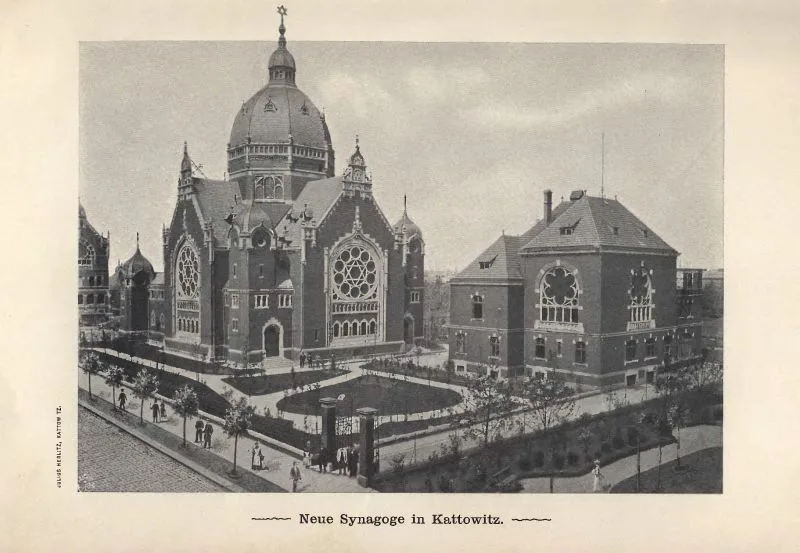
The no longer existing Great Synagogue in Katowice, opened in 1900, burned down in 1939 and demolished; on its site is Synagogue Square with a monument.
The Great Synagogue was the main synagogue of pre-war Katowice. It stood in today's Śródmieście district, on Mickiewicza Street. It was opened in 1900, burned down on 8 September 1939 and demolished. The building no longer exists, and Synagogue Square (plac Synagogi) now lies on its site.
The idea of building a larger synagogue appeared around 1890, because the old synagogue was too small, and among Katowice's Jews there were differences between conservatives and supporters of reform and assimilation. The building permit was issued in 1898. The design was made by the Katowice architects Max and Hugo Grünfeld, sons of Ignatz Grünfeld, who had built the old synagogue. The plot of 4,400 m² also housed a mikveh, a ritual poultry slaughterhouse and a matzah bakery.
The red-brick building with sandstone details combined Neo-Gothic, Neo-Renaissance, eclecticism and the Moorish Revival style. The most characteristic features were the ribbed dome over the main prayer hall, topped with a lantern and a Star of David, and the tall windows with tracery. The hall could hold about 1,120 people: 670 men and 450 women.
The Germans entered Katowice at the beginning of September 1939. The synagogue was set on fire on 8 September, and after the fire died down the cellars were dug up in search of valuables. In September 1939 the German building police ordered the community to demolish the ruins at its own expense. The community's undamaged buildings were later turned into a Gestapo seat. The ruins were demolished, and after the war rebuilding was considered but abandoned.
After the war the square was adapted as a green space. The name Synagogue Square was given in 1990, and in July 1988 a monument by Marian Kiciński with an inscription in Polish and Hebrew was erected here. The surviving Jewish community building, erected in 1937-1938, was later converted into a clinic. At the end of the 1990s a market began operating on the square.
From the square it is a short walk to the Silesian Theatre, which lies about 300 metres away, and to the Monument to the Silesian Insurgents.
The history of the city, including the Jewish community, is presented by the Katowice History Museum, about a kilometre from here.

Be the first! Add a comment.
You need to log in to add a comment.
Log in