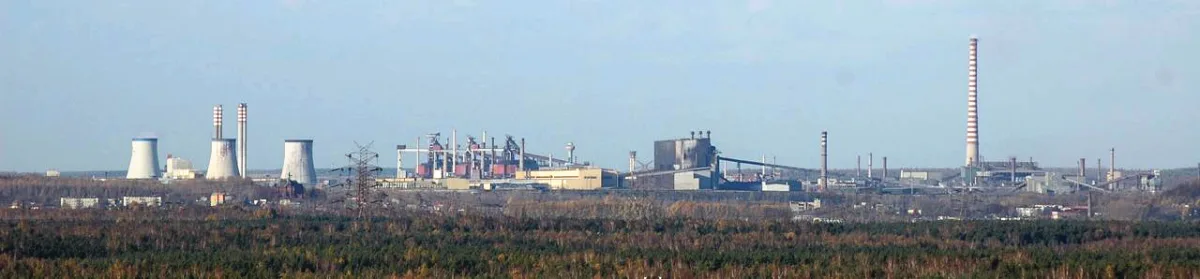
A steelworks complex in Dąbrowa Górnicza, built from 1972, with the first pig-iron tapping in 1976, today a branch of ArcelorMittal Poland.
Huta Katowice is a steelworks complex in Dąbrowa Górnicza, built in the 1970s in the Dąbrowa Basin. Today it operates as the Dąbrowa Górnicza Branch of the company ArcelorMittal Poland. The plant is working, so it is not a museum or a place for free sightseeing, but it is one of the most important points in the industrial history of the region, and the company occasionally opens its gates to registered visitors.
The decision to build the largest and most modern metallurgical complex in the People's Republic of Poland was taken at the 6th Congress of the Polish United Workers' Party (PZPR), and was in fact made by Edward Gierek. For the site, an area of more than 1,000 hectares was chosen between Gołonóg, Ząbkowice Będzińskie, Łosień and Strzemieszyce.
The building site took up about 2,500 hectares, mostly wooded land of the Łosień Forest. Earthworks and construction and assembly work began on 15 April 1972, in cooperation with the USSR and with about 50,000 workers. The construction changed the towns of the Basin: it brought a wave of migration, large housing investments and new connections, such as the Metallurgical-Sulphur Line (Linia Hutniczo-Siarkowa) with a conveyor for transporting iron ore.
Blast furnace no. 1 was lit on 2 December 1976, and the next day the first tapping of 30 tonnes of pig iron took place. Eight days later, on 11 December, the first 300 tonnes of steel were produced in basic oxygen converter no. 1.
In February 1977 a tram line was opened from the towns of the Basin to the plant's main gate. The start-up of the Large Rolling Mill in June 1978 completed the first stage of construction, and in November 1979 the Metallurgical-Sulphur Line was put into operation, becoming the main supply route for raw materials to the steelworks.
On the night of 12 to 13 December 1981, 41 members of “Solidarity” from the steelworks were interned. The workforce responded with an occupation strike that lasted 11 days. The plant was pacified on 23 December. A further 51 employees were interned later, a dozen or so were sentenced to prison terms, and part of the workforce was dismissed. It is one of the chapters of the steelworks' history that is spoken about in Dąbrowa Górnicza alongside the history of production itself.
In May 1976 the Huta Katowice Metallurgical Combine was established. In 1991 it was turned into a joint-stock company, and from 1 January 2003 the plant became part of Polskie Huty Stali (Polish Steelworks) as the Dąbrowa Górnicza Branch. In 2005 the company's name was Mittal Steel Poland, and since 2 October 2007 the name has been ArcelorMittal Poland.
Employment fell with restructuring: in 1992 the steelworks employed 23,240 people, and in 2001 only 5,170 (part of the workforce moved to spun-off companies). The record annual output, 4.87 million tonnes of steel, was recorded in 1997. The plant has, among other things, two blast furnaces, two rolling mills (Large and Medium), steelmaking shops with three basic oxygen converters, three continuous steel casting lines and its own combined heat and power plant. The company states that the plant is one of the few in the world producing rails 120 metres long.
Huta Katowice appears in the film “Man of Marble” (“Człowiek z marmuru”), and the scenery of its construction was the backdrop of the 1978 television series “Ślad na ziemi” (“A Mark on the Earth”). The steelworks is also the subject of the 2023 novel “Ciało huty” (“The Body of the Steelworks”) by Anna Cieplak.

Be the first! Add a comment.
You need to log in to add a comment.
Log in