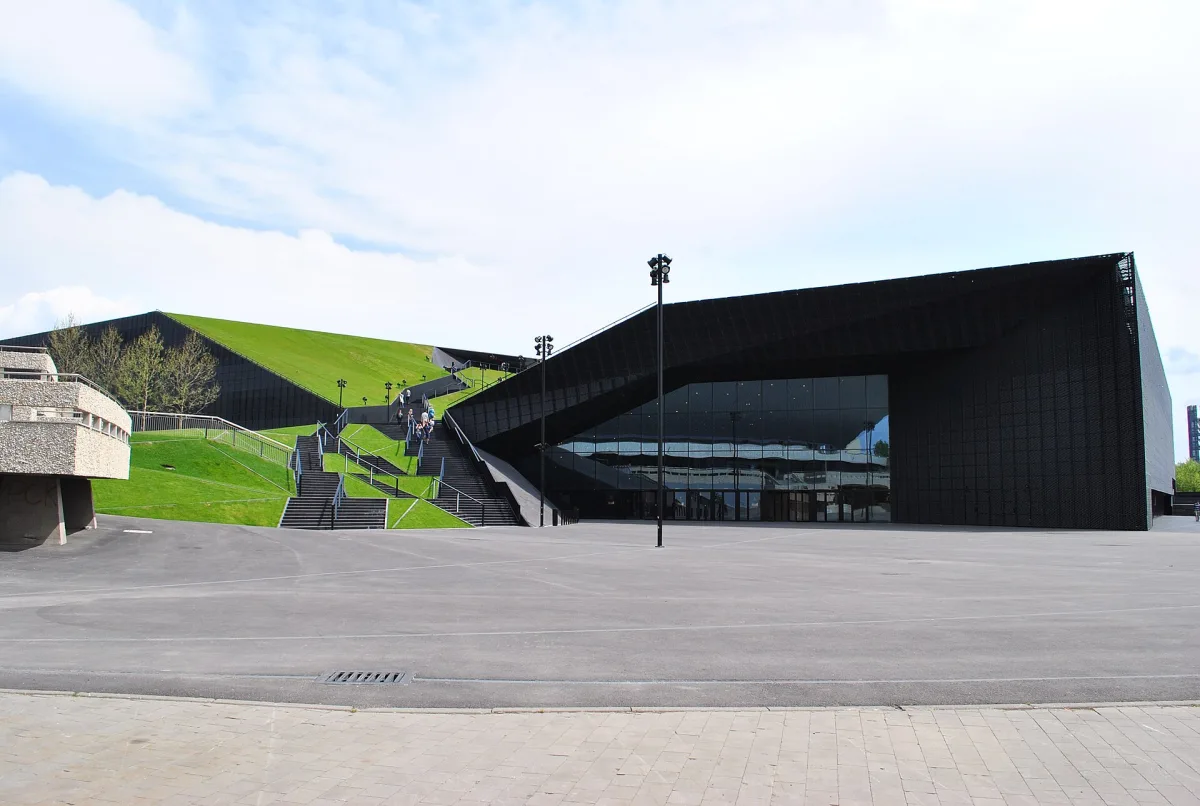
A congress centre with a green roof, opened in 2015 on the site of a former mine, with a hall for 8,000 people.
The International Congress Centre stands in Katowice on Sławik and Antall Square, on the site of the former “Katowice” mine, which closed in 1999. It opened in March 2015 as part of the Culture Zone, next to the Spodek arena, the seat of the Polish National Radio Symphony Orchestra and the Silesian Museum. For a visitor it is above all a building to see from the outside and a venue for large events.
The design was chosen in a competition decided in October 2008. It was won by JEMS Architekci of Warsaw, and the structural solutions were developed by the Warsaw firm KiP. Construction began in October 2011 and lasted until March 2015. The investment was co-financed by the European Union, and the city added its own funds.
The building has the simple form of a rectangular block measuring about 100 by 250 metres, with four storeys above ground and one below. A green roof of complex, multi-curved geometry, with a span of up to 30 metres, divides it into two parts. Descriptions of the project link the form with the mining past of the site, and the greenery on the roof softens the weight of the large volume. The total floor area is about 38,000 square metres.
The largest is the multi-purpose hall, measuring 135 by 60.5 metres and 12.5 metres high, which can be divided into three parts; it holds up to 8,000 people. The auditorium seats 600 people, the ballroom 1,000, and the 18 conference rooms (26 modules) hold 1,200 people in total. The foyer has a capacity of 1,500. Regular events at the centre include the European Economic Congress and Intel Extreme Masters, and the COP24 climate conference and Wikimania were held here in some of their editions.
The building won several major architectural awards for 2015, including the Grand Prix in the Architecture of the Year, Polityka, Building of the Year, SARP and Polish Architecture competitions.
The centre forms a group with nearby cultural buildings. Right next door, about 200 metres away, stands the seat of the Polish National Radio Symphony Orchestra, and about 600 metres further on is the Silesian Museum, which has kept the mine's former winding tower. The memory of the Silesian Uprisings is kept alive by the nearest Monument to the Silesian Insurgents, about 300 metres from the centre.

Be the first! Add a comment.
You need to log in to add a comment.
Log in