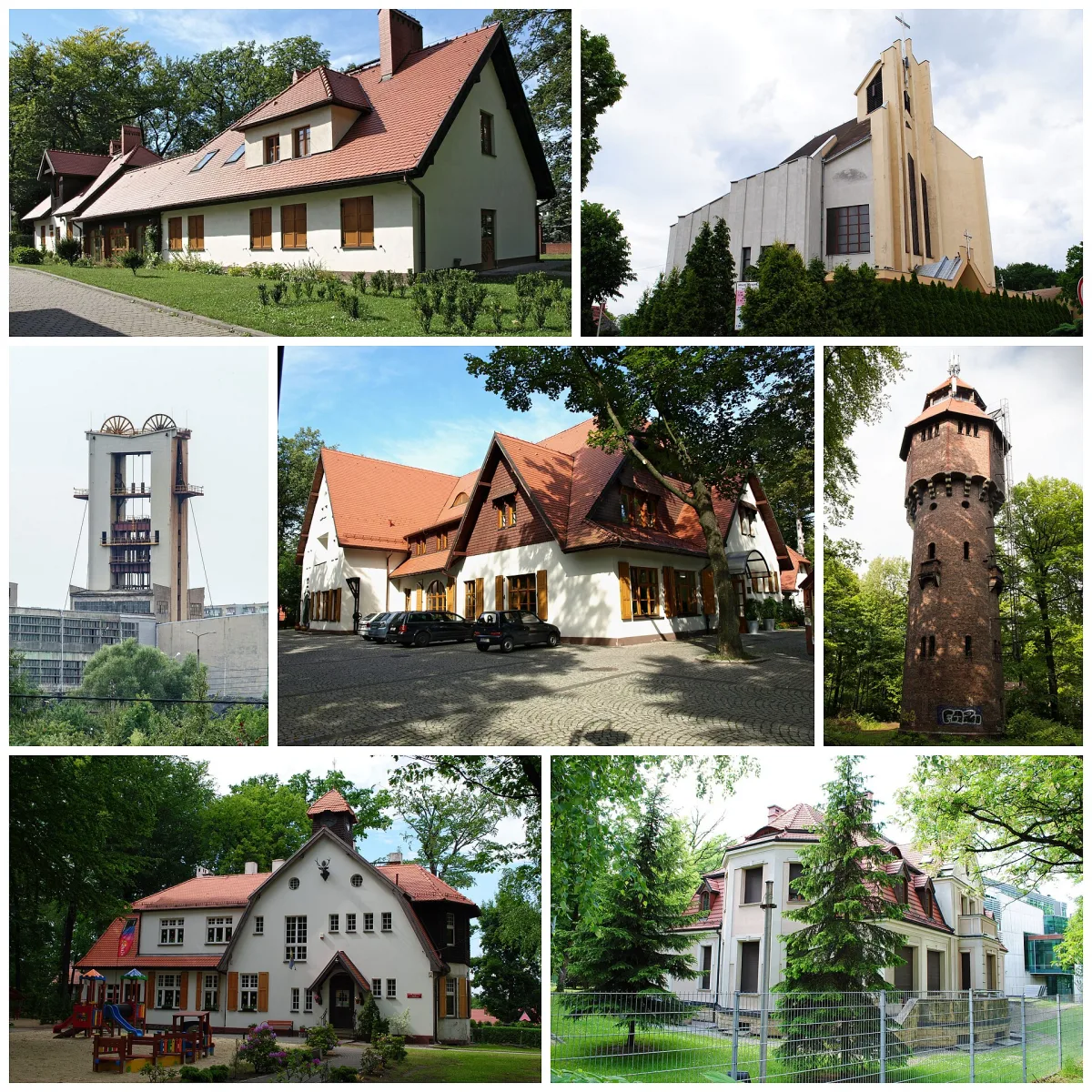
A mining settlement from 1907-1910 designed on the garden city idea, about one third of which has survived.
Giszowiec is a former mining settlement in the south-eastern part of Katowice, built in 1907-1910 on the garden city idea. About one third of the original development has survived, but the layout with a green square in the centre is still legible.
Giszowiec was built for the miners of the Giesche mine. The land was bought in 1899 from Franz Hubert von Tiele-Winckler, and the design was prepared by the Berliners Georg and Emil Zillmann, who based it on Ebenezer Howard's garden city concept.
The manor district was created on 1 July 1907. The first residents moved in on 1 October 1908, and in December 1909 the settlement had 3,414 inhabitants. Housing was planned for 642 families, mainly workers' families, but also officials and teachers.
The settlement consisted of single-family and two-family houses among preserved old beech and oak forests, and in the centre was the Pod Lipami square.
Besides the housing, a Catholic and a Protestant school, a church, the manor district administration building, a water tower and a bathhouse with a laundry were built. Some of these buildings can still be seen today, including St Barbara's Church and the water tower.
In the 1970s and 1980s about two thirds of the historic settlement was demolished, and ten-storey prefabricated blocks of flats were built in its place. The surviving parts were placed under heritage protection in 1978 and 1987.
In 1979 the estate was officially named after Stanisław Staszic, but the residents stuck to the name Giszowiec, which was officially restored in 1990. The demolitions became the backdrop to Kazimierz Kutz's film "Paciorki jednego różańca".
According to the website devoted to the estate, you can see former school buildings, a pharmacy, a post office, a fire station and the water tower, and nearby two parishes, St Barbara's and St Stanislaus Kostka's. The Giszowiec park also lies nearby.
For those who want to understand what the settlement looked like, the Trail of Vanished Monuments has been prepared, which leads through ten places of destroyed buildings and is based on maps and archive photographs. Giszowiec is also part of the Industrial Monuments Route, like nearby Nikiszowiec, located about 2.6 km away.

Be the first! Add a comment.
You need to log in to add a comment.
Log in