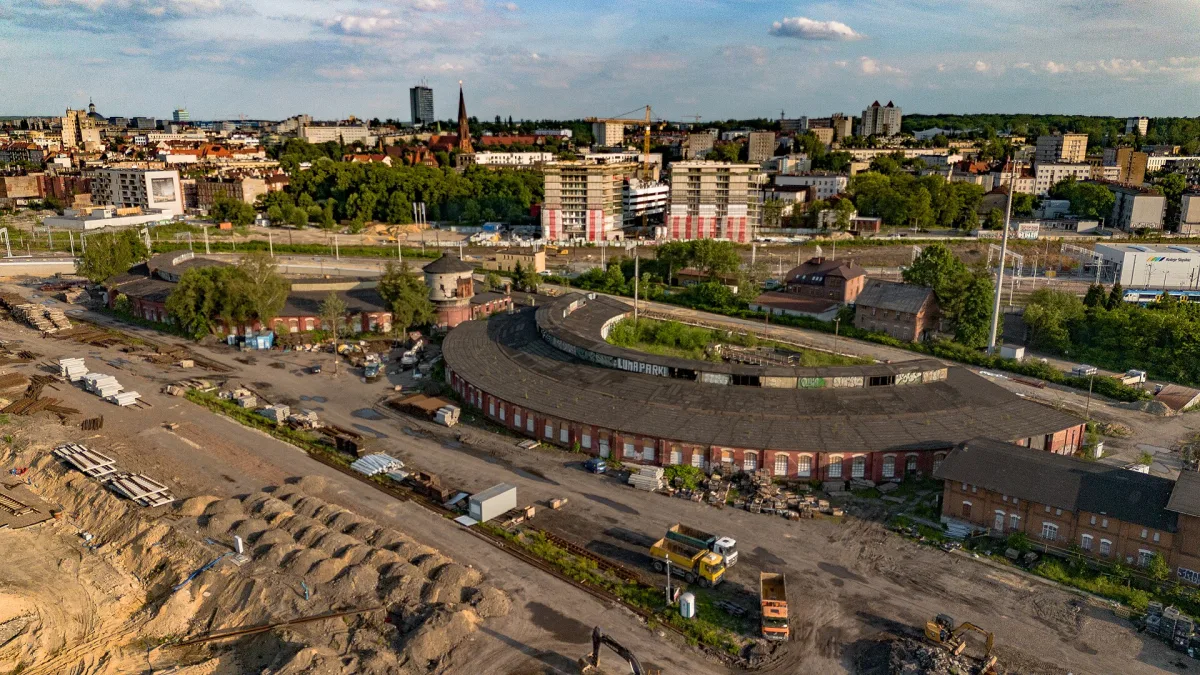
An abandoned locomotive depot with two fan-shaped halls from 1900, entered in the heritage register in 2021.
The Katowice Locomotive Depot is an abandoned railway complex from the turn of the 19th and 20th centuries on Raciborska Street, in the western part of Katowice station. It has two fan-shaped halls arranged in a layout close to a half-moon, and there are few such facilities in Poland.
The railway reached Katowice in 1846. In 1859 a fan-shaped engine shed for four locomotives with a large turntable was built here, pulled down in 1862. The present complex began to be built in 1899 to a design by Lohse and Zebrowski, and the western hall was ready in spring 1900. Later an Intze-type water tower (1899-1900), a washhouse with a bathhouse (1903), a dormitory for crews (1908), a steel footbridge to Kamienna Street (1908), the eastern part with twelve additional tracks (1909) and a workshop (1911) were added.
The halls are single-storey, in a simple brick historicism. The western one covers about 4,900 square metres, the eastern about 4,080. The two turntables, each 20 metres in diameter, were designed with electric drive. The water tower has richly decorated walls. Vehicles were placed over inspection pits inside the halls. In 1903 about 64 locomotives were serviced here daily, and 294 people worked here.
The depot was closed on 1 March 2011; earlier it had been used for inspections and repairs of locomotives. Ideas for setting up a museum here appeared in 2011 and 2013 but came to nothing. After protection was withdrawn the site was vandalised and robbed. The Voivodeship Conservator of Monuments initiated proceedings, and on 16 December 2021 the complex was entered in the heritage register. In October 2021 a fire destroyed the two-storey administrative building, and in January 2022 a second fire damaged the former workshop room. After the listing the water tower had gaps in its roof and a damaged tank, and the general condition of the buildings was poor.
A kilometre from here stands the Cathedral of Christ the King, and next to it the Silesian Theatre.

Be the first! Add a comment.
You need to log in to add a comment.
Log in