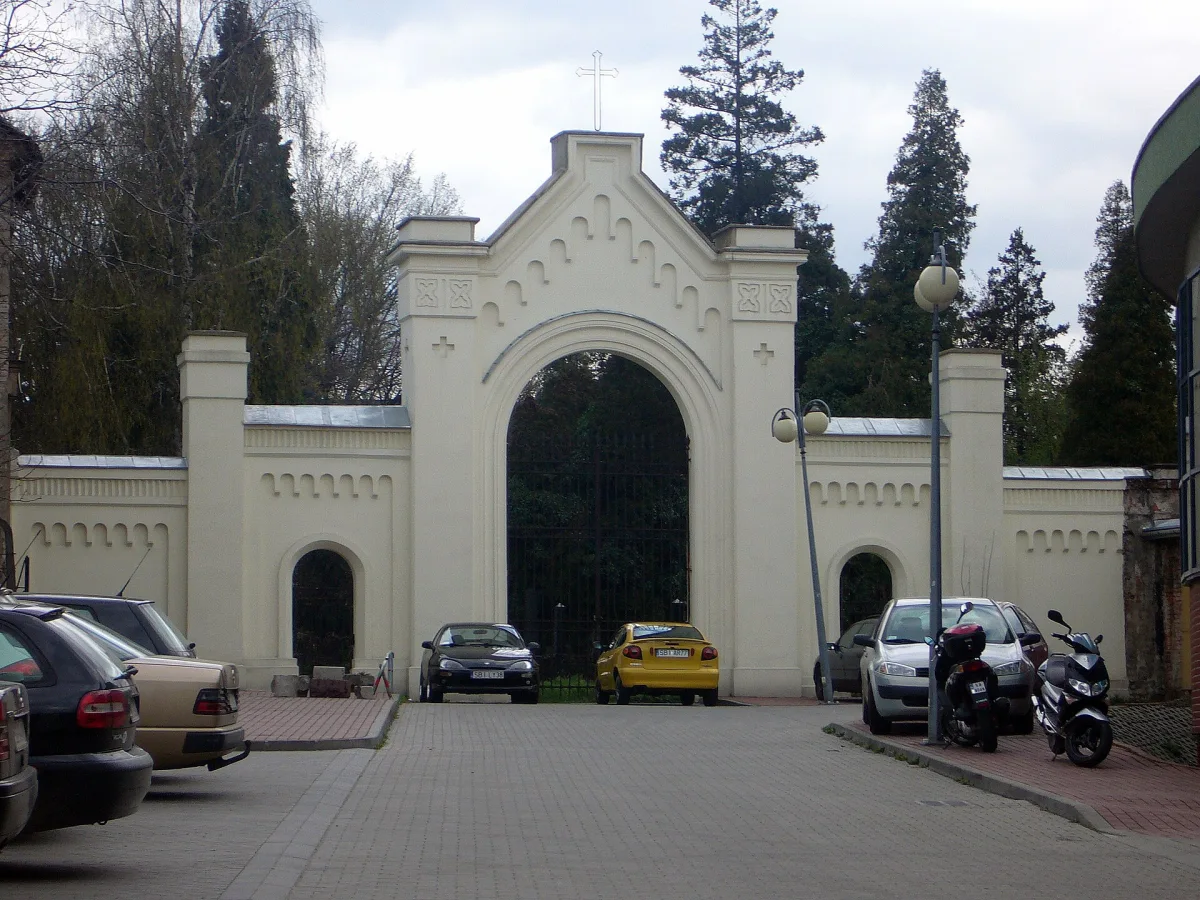
A disused Evangelical necropolis from 1833 on Bielsko Zion, with a neo-Gothic gate and the Avenue of the Distinguished.
The Old Evangelical Cemetery in Bielsko-Biała is a disused necropolis founded in February 1833 on Andrzeja Frycza-Modrzewskiego street, on the so-called Bielsko Zion.
The cemetery was founded on land donated by the soap maker Gottlieb Klimke. The decision was hastened by the cholera epidemic of 1831. Earlier, Protestants and Catholics had buried their dead together in the cemetery by the Holy Trinity church. In the 1860s the site was considerably enlarged, and in 1911 the New Evangelical Cemetery was opened on Listopadowa street. Burials at the old cemetery nevertheless continued until the time of the Second World War.
The necropolis has seven sectors. It is entered through a neo-Gothic gate with three arcades from 1863. The oldest surviving gravestone dates from 1857. The most impressive part is the Avenue of the Distinguished (Aleja Zasłużonych), running from south to north, along which the wealthiest and most distinguished residents of the town were buried.
Buried here are mayors of the town, among them Karl Ferdinand Sennewaldt, Moritz Scholz and Heinrich Hofmann, pastors, the industrialists Gustav Förster and Hermann Schneider, the activist Theodor Sixt and the scholar Philipp Johann Ferdinand Schur.
After 1945 the cemetery was regularly vandalised, and the authorities demanded the removal of German-language gravestones. To save them, descendants of those buried painted over the inscriptions or turned the slabs face down. After 1989 the town restored a few gravestones. For more than 70 years the cemetery has not accepted burials, and protected trees, ivy and other plants cover the gravestones, walls and paths. Nearby are the Władysław Reymont Museum of Literature and the Cathedral of St Nicholas.

Be the first! Add a comment.
You need to log in to add a comment.
Log in