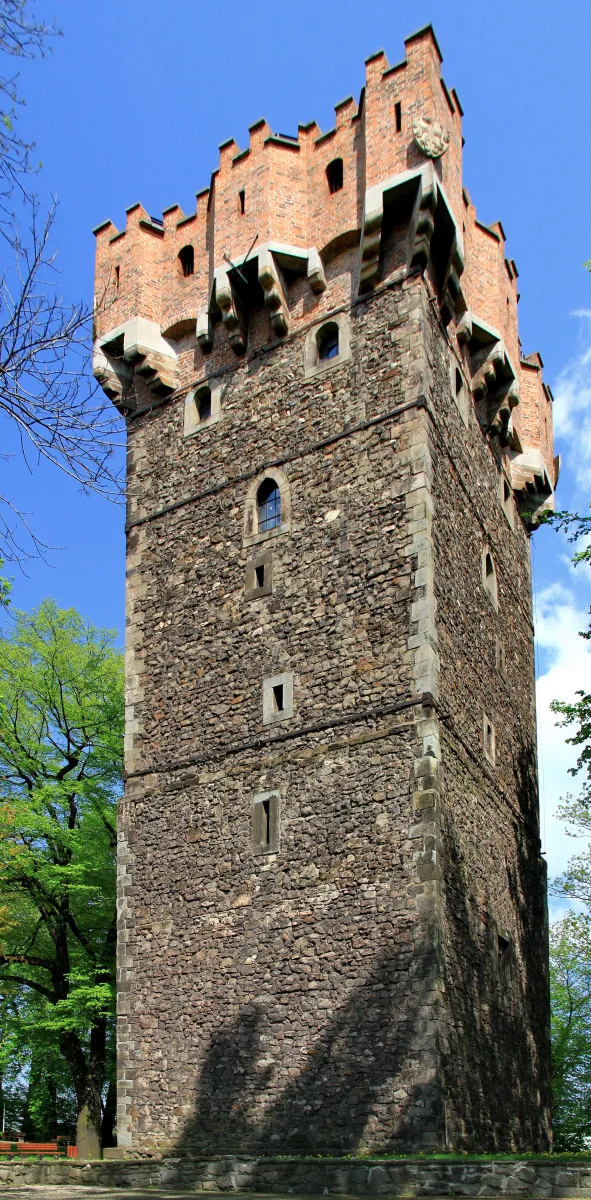
A Gothic defensive tower of the former castle of the Dukes of Cieszyn from the 14th century, with an observation terrace at the top.
The Piast Tower in Cieszyn is a Gothic defensive tower of the former castle of the Dukes of Cieszyn on Castle Hill, built in the first half of the 14th century. Of the four towers that once stood here only this one survived, and at almost 30 metres high it is regarded as a symbol of the town and its Piast past.
In the second half of the 14th century the tower was raised and decorated with four corner coat-of-arms shields with Piast eagles. At the end of the 15th century another storey was added with a brick defensive gallery and crenellation, and a high pavilion roof.
The castle was struck by fires in 1484, 1520, 1552, 1570 and 1603. In 1647, during the Thirty Years' War, Austrian troops besieged a Swedish garrison, and the bombardment damaged the roof, the corner turrets and a large part of the upper sections of the tower. The castle gradually fell into ruin.
In 1819-1840 the pavilion roof was replaced with a mansard roof and a clock was installed. The renovation of 1976-1989 brought an observation terrace at the top and the repair of the crenellation and the eagle shields. The upper part of the crenellation was repaired again in 2015.
The tower has a square plan and is built of quarry stone, with dressed stone at the corners and window surrounds, and of brick in the upper sections. The walls at the base are up to 2 metres thick and narrow towards the top. Sources give the height differently (from 24 to almost 30 metres).
The interior is divided into four parts: an underground level about 6 metres deep (the former dungeons), a storage part, a residential part and an upper defensive storey. Tradition links the coat-of-arms shields with the workshop of Peter Parler. In the rock under the tower there is also a 65-metre tunnel, where beer and ice were once stored.
120 steps lead to the top. From the terrace you can see Cieszyn, Czech Cieszyn, and in good visibility the Silesian Beskids and the Moravian-Silesian Beskids.
Next to it stands the Rotunda of St Nicholas, and nearby the Habsburg Hunting Palace. A little further on is the Three Brothers' Well.


Be the first! Add a comment.
You need to log in to add a comment.
Log in