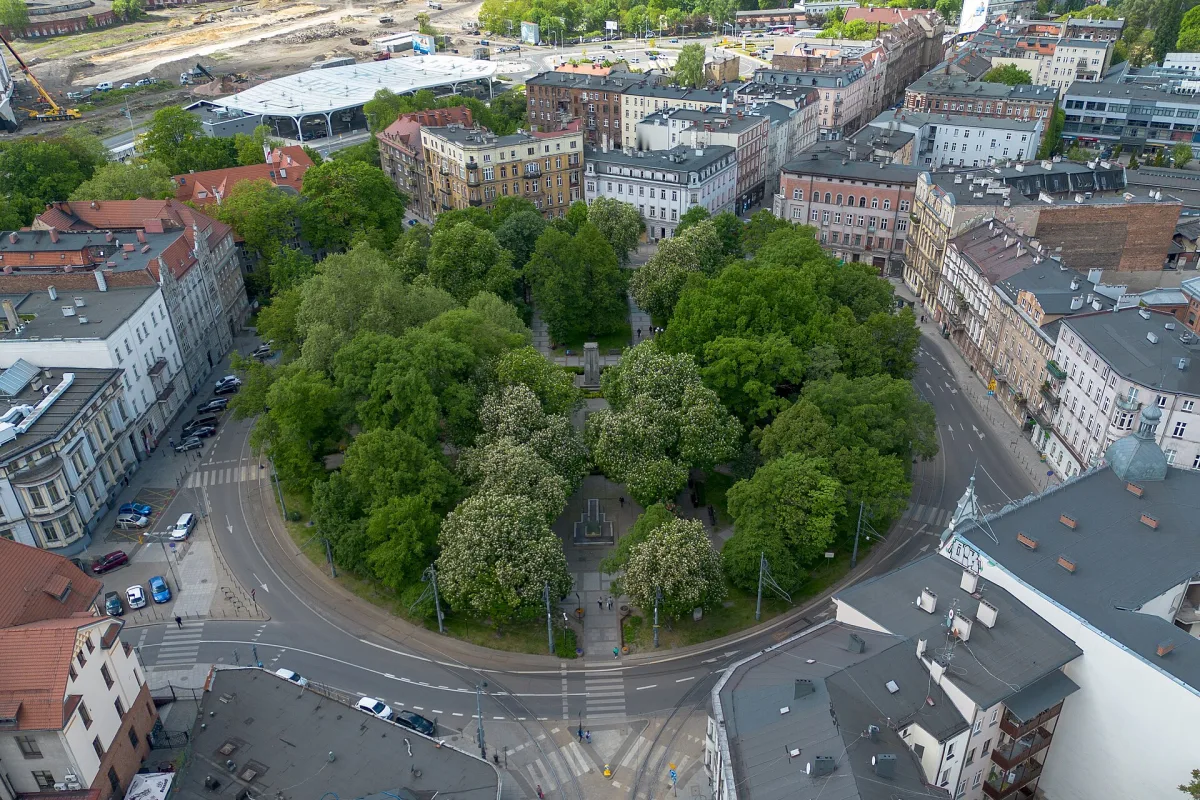
A hexagonal square from the 1856 plan of Katowice, surrounded by tenement houses entered in the heritage register and the Goldstein Palace.
Freedom Square (Plac Wolności) is a hexagonal square in the western part of the centre of Katowice, from which 3 Maja, Sokolska, Gliwicka, Matejki and Sądowa streets radiate. It is one of the oldest areas of the city and has kept to this day the layout set out in the mid-19th century.
The square was laid out on the basis of the 1856 spatial development plan of Katowice, authored by Heinrich Moritz August Nottebohm. It lies on the main axis of the city, which today is formed by 3 Maja Street, the Market Square (Rynek) and Warszawska Street. The northern and southern sides are about 100 m long, and the two western and two eastern sides about 70 m each. In the middle is greenery, with a roadway and a tram line around it.
The regulation of the square was completed in 1876, with trees and shrubs planted and lawns laid out. Before 1922 it was called Wilhelmsplatz.
In 1898 a monument to the two German emperors, Wilhelm I and Frederick III, carved by Felix Görling, was unveiled in the middle; it was blown up in 1920. After the creation of the Silesian Voivodeship, the monument-tomb of the Unknown Silesian Insurgent stood here, unveiled in 1923. After the war a monument to the soldiers of the Red Army was put up, which was dismantled in 2014, and the city assigned the empty plinth to presentations of works by local artists. The memory of the Silesian Uprisings is kept alive today by the Monument to the Silesian Insurgents in another part of the city.
Around the square stand tenement houses from the late 19th and early 20th centuries, many entered in the heritage register. The Goldstein Palace (Plac Wolności 12a), completed in 1875 in the Neoclassical style, has a distinct history. The villa at number 10, built in 1907-1909 to a design by Ludwig Goldstein, houses the Katowice-West District Court today. The tenement house at number 9, from 1901, is also the work of Ludwig Goldstein.
In 2000 a fountain was built with a system of glass panes covering 35.6 m2. In a residents' poll in 2005 it was given the name Aquarium. In 2013-2014 the surface of the square was thoroughly modernised. Today it is an important tram and bus hub, housing among others the District Court, the Registry Office and music clubs.
The Cathedral of Christ the King is about a kilometre from here, and the Silesian Theatre less than a kilometre.

Be the first! Add a comment.
You need to log in to add a comment.
Log in