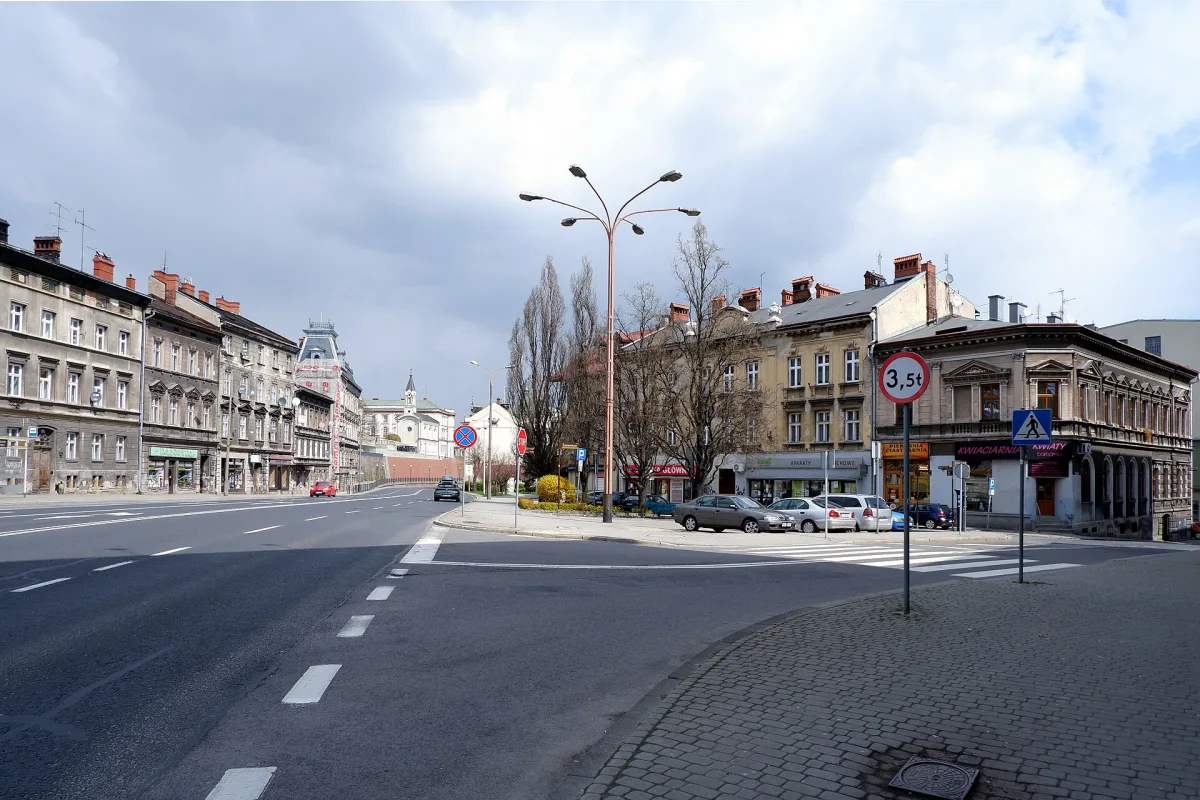
A square in the centre of Bielsko-Biała with tenement houses from the turn of the 19th and 20th centuries and the Żwirki and Wigura monument.
Plac Żwirki i Wigury is a square in the centre of Bielsko-Biała, in the Żywieckie Przedmieście area, at the junction of the streets Zamkowa, Partyzantów, Sukiennicza, Przekop and Władysława Sikorskiego. Today's layout consists of a green square, a car park and the four-lane ulica Partyzantów.
Before 1896 there was dense development here known as Hirsewinkel, and the open Młynówka (mill stream) flowed through. In 1896-1908 the old houses were demolished and the watercourse was covered, and the resulting square was named Gustav-Josephy-Platz. In 1918 it became Plac Wyzwolenia (Liberation Square), and in 1933 it took its name in honour of the aviators Żwirko and Wigura. During the war it was called Goetheplatz. In 1971 the tram line here was closed, and in 1973-1974 a traffic rebuilding swallowed the Bazary Zamkowe (Castle Bazaars) and many tenement houses.
Surviving by the square are, among others, the Neo-Renaissance Rübner tenement at number 4, the Art Nouveau Schimanek tenement from 1909 at number 9 and the Art Nouveau and Neo-Baroque Büttner tenement from 1905 at number 12. A little further on, in the former Karl Büttner's Söhne factory from 1887, is the Stara Fabryka.
In the middle stands a monument to the patrons of the square in the form of a simplified eagle. 14 bus lines of MZK Bielsko-Biała stop at the square.

Be the first! Add a comment.
You need to log in to add a comment.
Log in