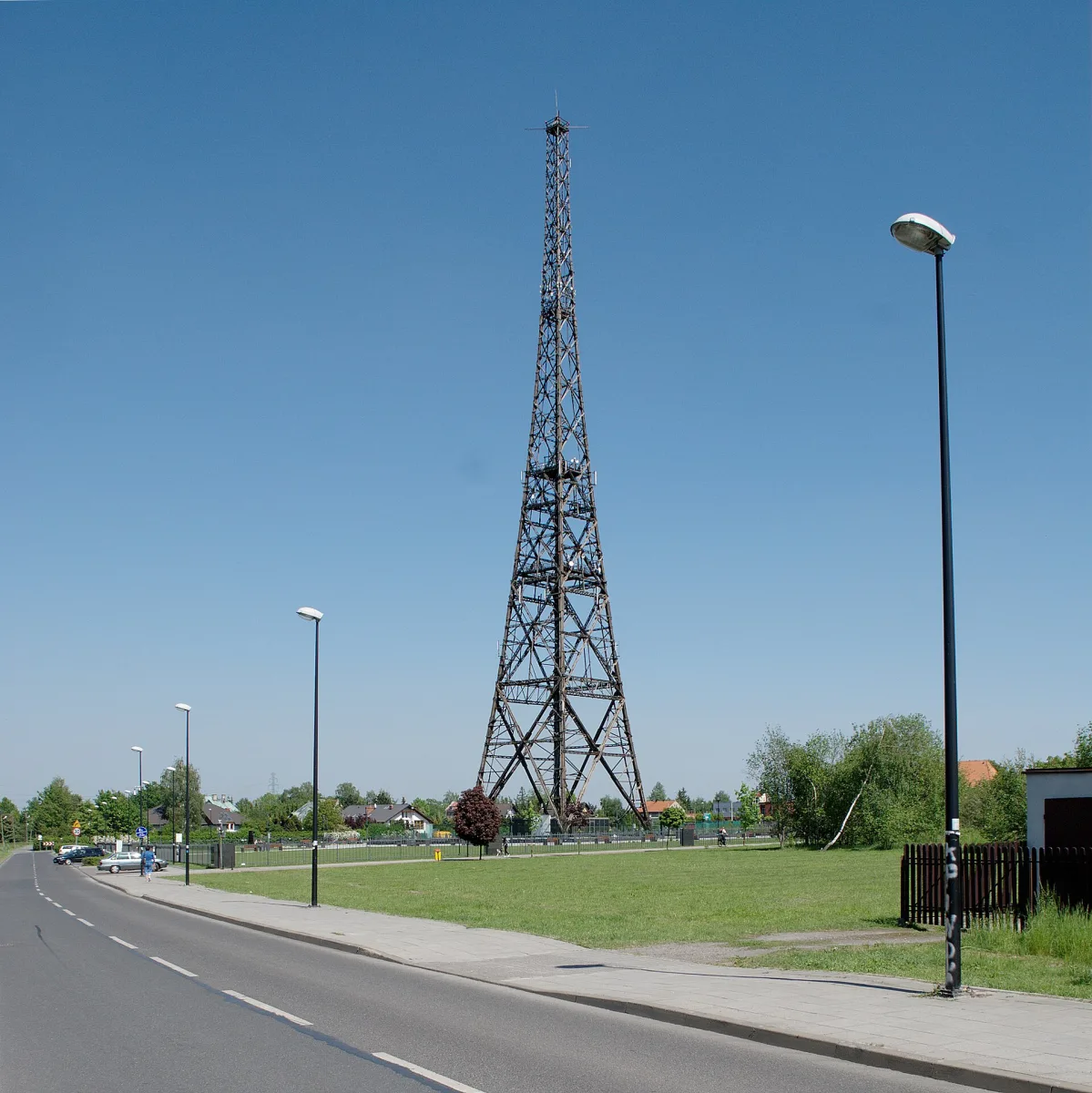
A radio station complex from 1935 with a 111-metre wooden antenna tower, a branch of the Gliwice Museum and a Monument of History; the site of the Gleiwitz incident of 1939.
The Gliwice Radio Tower is a complex of three buildings and a wooden antenna tower, built in 1935 in what was then Gleiwitz. The tower is 111 m high and is regarded as the tallest surviving structure built entirely of wood in Europe and the tallest wooden antenna tower in the world. The site is also known as the scene of the Gleiwitz incident of 31 August 1939. Today the complex, entered on the list of Monuments of History, is a branch of the Gliwice Museum.
The transmitting station on what is now Tarnogórska Street was put into operation on 22 December 1935 with a power of 8 kW. The wooden tower was assembled within five months. It was made by the firm Christoph & Unmack of Niesky. The material was larch beams, joined with pegs and more than 16,000 brass screws, without a single steel nail. The tower has four platforms and a square base of 20 by 20 m, and a system of ladders with 365 rungs leads to the top.
From 1937 the Gliwice station served as the "mother station" of the Silesian synchronous network and broadcast the same programme as the station in Görlitz, relayed from Wrocław. According to zabytek.pl the complex was built in 1934-1936. It has been in the heritage register since 1964.
On the evening of 31 August 1939 a German SD group under the command of Alfred Naujocks, dressed as Polish insurgents, broke into the radio station. The action was part of a German false-flag operation meant to provide a pretext for the attack on Poland. The group went to the transmitting station and not to the studio, which was about four kilometres away, so broadcasting the message was difficult.
To stage a Polish attack, the bodies of murdered prisoners dressed in Polish uniforms were used. Among the victims, Franciszek Honiok of Łubie is named, a German citizen of Polish nationality, detained the day before by the Gestapo. German propaganda used the event as supposed proof of Polish aggression, and in the early hours of 1 September Germany began the invasion of Poland.
The radio station operated until 22 January 1945, when the Red Army began to enter the city. From 23 October 1945 Katowice programmes were broadcast from here. In 1950 broadcasting was taken over by the transmitter in Ruda Śląska, and Gliwice began to jam foreign stations, mainly Radio Free Europe, which lasted until 1956. Later the building was used to produce medium-wave transmitters. In 2002 the city bought the complex back, and in 2005 it was taken over by the Gliwice Museum.
The main building has retained almost the complete equipment of the former station, produced in 1934 by the firms Lorenz, Telefunken and Siemens & Halske. It includes a 12-kilowatt Lorenz transmitter, which in 1963 went to the Museum of Technology in Warsaw and returned to its former place in 2013. In 2009 the three-hectare property was turned into a publicly accessible park.

Be the first! Add a comment.
You need to log in to add a comment.
Log in