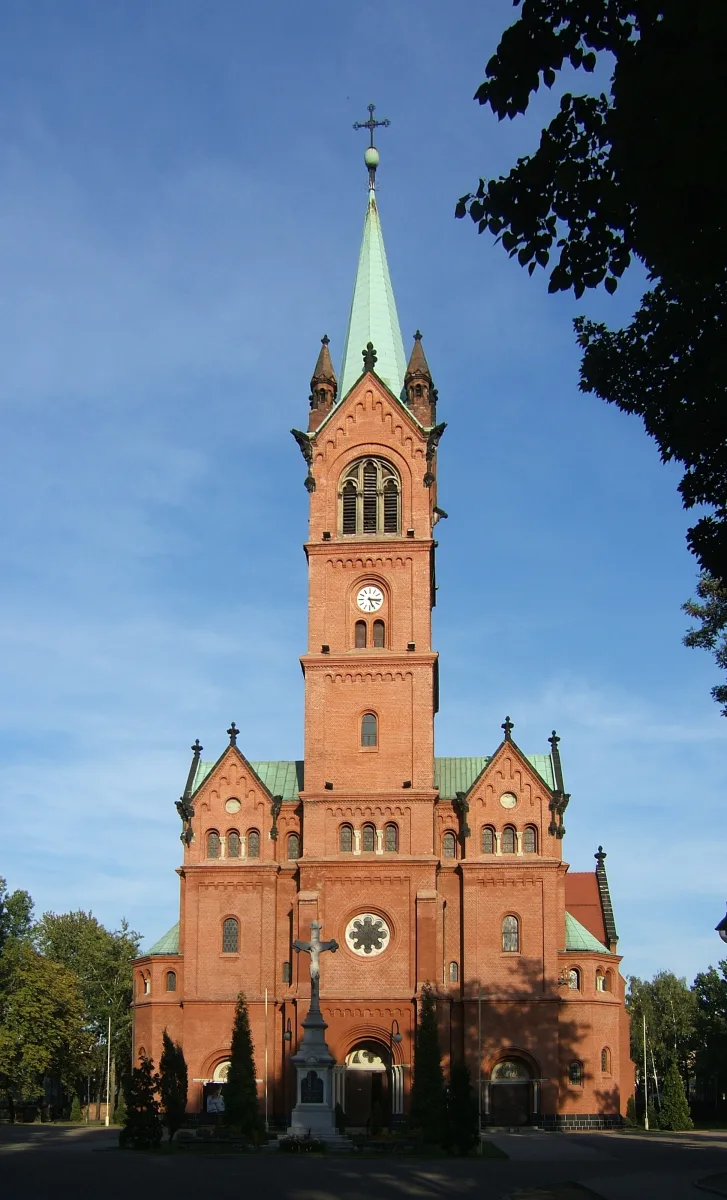
Clinker-brick church of 1897-1900 in Zabrze, in the Neo-Romanesque style with Neo-Gothic elements, with its original furnishings and organ.
St Anne's Church stands in Zabrze, in the former village of Dorota. It was built in 1897-1900 of clinker brick, in the Neo-Romanesque style with Neo-Gothic elements. Almost all of its original furnishings have survived, and it was entered in the heritage register in 2010.
The church was designed by the building councillor Blau of Bytom and the Bytom architect Stahl. The foundation stone was laid on 5 September 1897, and the church was consecrated on 10 October 1900. It stands on the site of the former village of Dorota, which has belonged to Zabrze since 1905. In 1945 the building was damaged.
The church was built on a Latin cross plan as a three-aisled hall with a transept, under a gable roof. A tower with a belfry and a clock rises on the axis of the façade. The clinker-brick elevations are decorated with brick ornaments and stonework details. Characteristic features are the large, round-arched windows with stained glass depicting saints, and the galleries of the side aisles and transept arms. The whole is completed by the presbytery, the parish house and an avenue with a gate, planted with maples and lime trees.
The interior has preserved its original furnishings, including the altar of St Anne, the pulpit, marble altar rails and a Stations of the Cross in box form. A wrought-iron screen separates the chancel from the rest of the church. Apart from the polychromes, the original furnishings have survived almost entirely. On the gallery above the entrance stands a 47-stop organ by Schlag & Söhne of Świdnica, completed in 1900, with three manuals and a pedal, in a Neo-Romanesque case. Six bells hang in the tower; this is the church's third set, because the earlier ones were taken to be melted down during both wars.

Be the first! Add a comment.
You need to log in to add a comment.
Log in