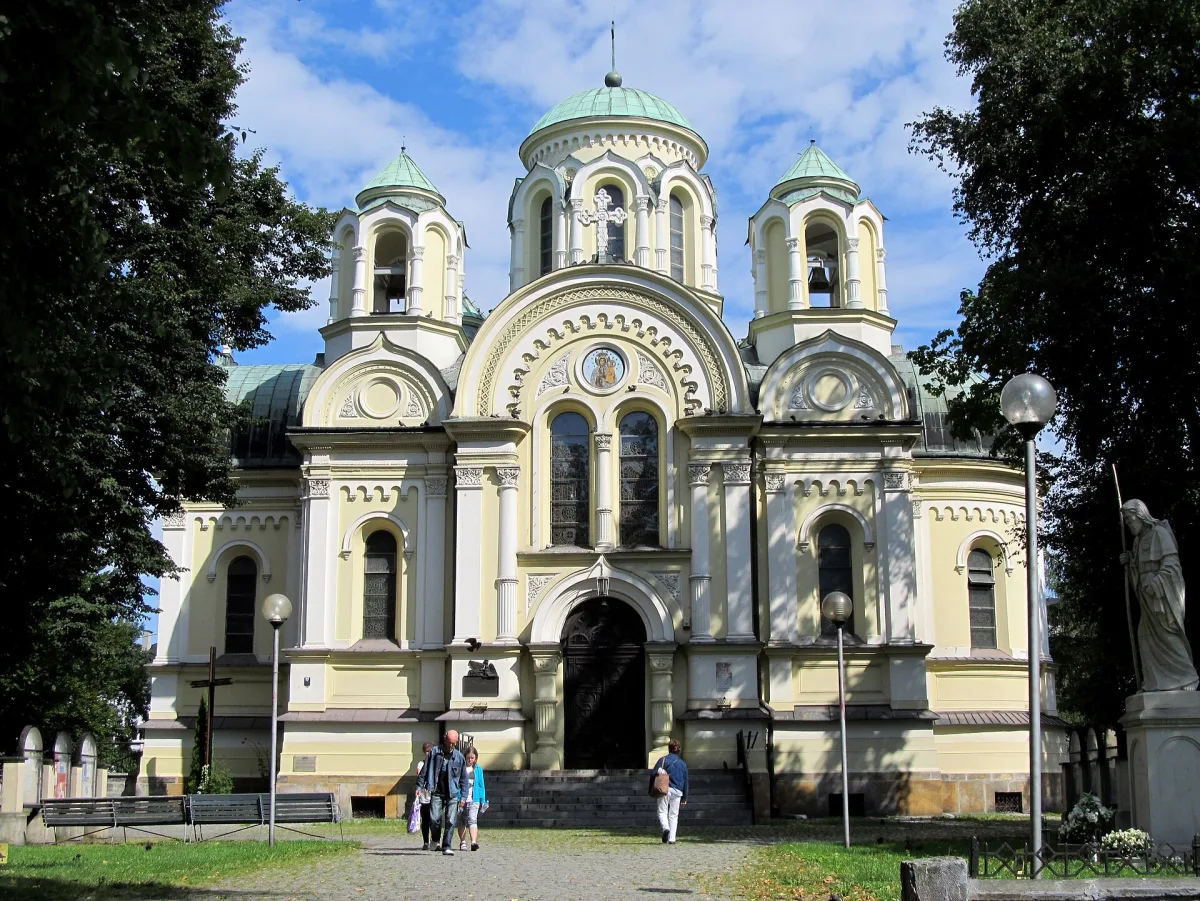
A former Orthodox church from 1870-1872 in central Częstochowa, now a Catholic parish church with features of Neo-Byzantine architecture.
St James's Church stands in central Częstochowa, on Władysław Biegański Square, about a kilometre from Jasna Góra. The building has an interesting history: it was built as an Orthodox church, and today it is a Catholic parish church that still keeps features of Neo-Byzantine architecture.
Around 1582 Jakub Zalejski built a timber chapel of St James on this spot, with a shelter for sick pilgrims. It then stood on open ground between Częstochowa and Częstochówka. About sixty years later the Pauline provincial Andrzej Gołdunowski funded a new, brick chapel. In 1683, on his way to Vienna, King John III Sobieski visited it on the name day of his son James.
When the religious order that used the church was dissolved in 1864, the abandoned church began to fall into ruin. In 1869 the tsarist authorities took over the site, and in place of the chapel they built, in the Byzantine style, the Orthodox church of Saints Cyril and Methodius to a design by Aleksander Lie, modelled on the Orthodox church of St Mary Magdalene in Warsaw. It was consecrated on 15 October 1872. In the heritage register the building is listed as stone, dated 1870-1872.
After the Germans entered the town in 1914 the Orthodox church became a Catholic garrison church, and after independence was regained it remained in Catholic hands. In 1937 the Bishop of Częstochowa established the parish of St James here. Plans to demolish it and build a modern church to a design by the Kraków architect Zygmunt Gawlik were cut short by the war. In 1943 the German authorities handed the building to the Orthodox population, and in 1946 it became a Catholic church again; it was handed to the parish in 1947.
In 1948 the parish priest removed the Byzantine domes: the central one was replaced with a semicircular dome and the side ones with conical roofs. In 1969-1974 the interior was rebuilt in the form of an early Christian church to a design by Stanisław Pospieszalski. The walls were decorated with sgraffiti by Maria Antonina Kozłowska and Zofia Szczerba, and the side walls were covered with wooden panelling.

Be the first! Add a comment.
You need to log in to add a comment.
Log in