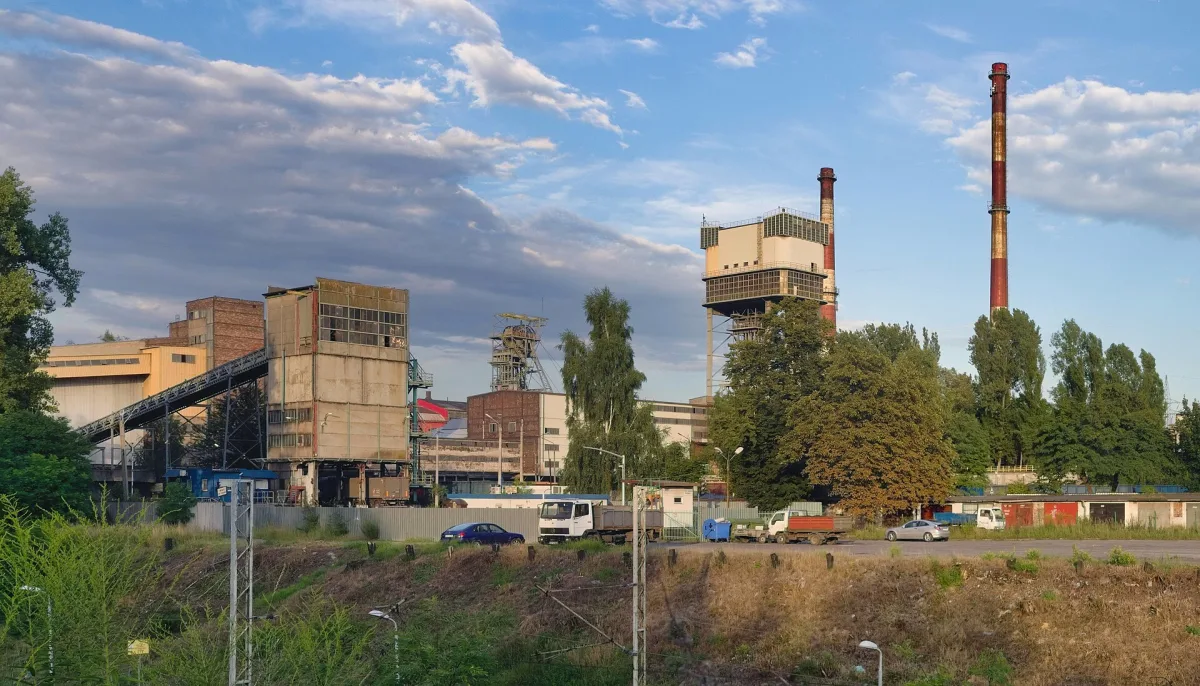
A hard coal mine in Katowice, active from 1900 to 2021, the site of the pacification of the strike of 16 December 1981.
The Wujek Coal Mine lies in Katowice, in the Załęska Hałda-Brynów district, along Pola Street. It extracted coal from 1900 to the end of November 2021. It was created as the “Oheim” mine, and its name changed to “Wujek” in 1922. It is also the site of the pacification of the strike on 16 December 1981, in which nine miners died.
The “Oheim” mining field was granted in 1842, but for decades no works were opened on it. In 1895 the Oheim Mining Company was established, in which the majority of shares were held by Prince zu Hohenlohe-Öhringen, and in 1897 he took over the mining works from Franz Hubert von Tiele-Winckler. The mine was started in 1899, the first workers were taken on on 1 October, and the first shaft was named “Hohenlohe” (from 1936 “Lechia”). The second, “Kramsta”, has been called “Krakus” since 1936. The first coal from the 63-metre level was extracted on 7 November 1900.
In 1922 part of Upper Silesia, together with the mine's grounds, was incorporated into Poland, and the works were renamed “Wujek”. During the German occupation the mine belonged to the Reichswerke Hermann Göring concern, and Soviet prisoners of war also worked in it. At the end of the occupation, in January 1945, the Germans planned to blow up the winding shaft and flood the mine, which the workforce prevented. After the war the works resumed operation on 5 February 1945.
After martial law was introduced, on the night of 12 to 13 December 1981 the mine's workforce began a strike. The events that led to it are described in the chronicle on the website of the Silesian Centre of Freedom and Solidarity: the attack by the Citizens' Militia and ZOMO on the home of the chairman of the works “Solidarity” union, Jan Ludwiczak, and his detention, and the demands of the strikers, among them the release of the interned and the lifting of martial law. On 16 December 1981 Militia and ZOMO units carried out the pacification of the mine. The use of live ammunition by motorised Militia units caused the death of seven miners on the spot, two more died in hospital after several days, and over 40 people were taken to hospitals with gunshot wounds, fractures and other injuries.
The place where the miners died became an object of veneration. In a breach in the wall made when a tank drove in, a cross was left, which was destroyed on the night of 27 to 28 January 1982. In 1989 the Committee for the Construction of a Monument in Honour of the Miners of the Wujek Mine was registered, and the monument was blessed on 14 December 1991. The events are recounted in Kazimierz Kutz's 1994 film “Death as a Slice of Bread”.
Part of the historic buildings from the early 20th century has survived. Among them are the pithead with the winding tower of the “Krakus” shaft from 1912, the engine house of that shaft, the compressor house with the former engine house of the “Lechia” shaft from 1902, a boiler house with two chimneys 102 metres high, workshops, sorting plants, administration and lamp-room buildings, and a water tower from 1902. The former main warehouse from 1904, entered in the heritage register in 2015, is the seat of the Silesian Centre of Freedom and Solidarity.
In 2005 the “Śląsk” mine in Ruda Śląska was merged into the mine, and from 2021 the mine was part of the “Staszic-Wujek” plant. The plant is in liquidation, and the city of Katowice and the mining company are agreeing on the transfer of some of the facilities to the city and the development of the former mine grounds. The scope of these plans is changing, so current information is provided by Katowice and the owner of the land.
It is not far from here to the centre of Katowice: about 1.2 km to Tadeusz Kościuszko Park and about 2.3 km to the Cathedral of Christ the King.

Be the first! Add a comment.
You need to log in to add a comment.
Log in