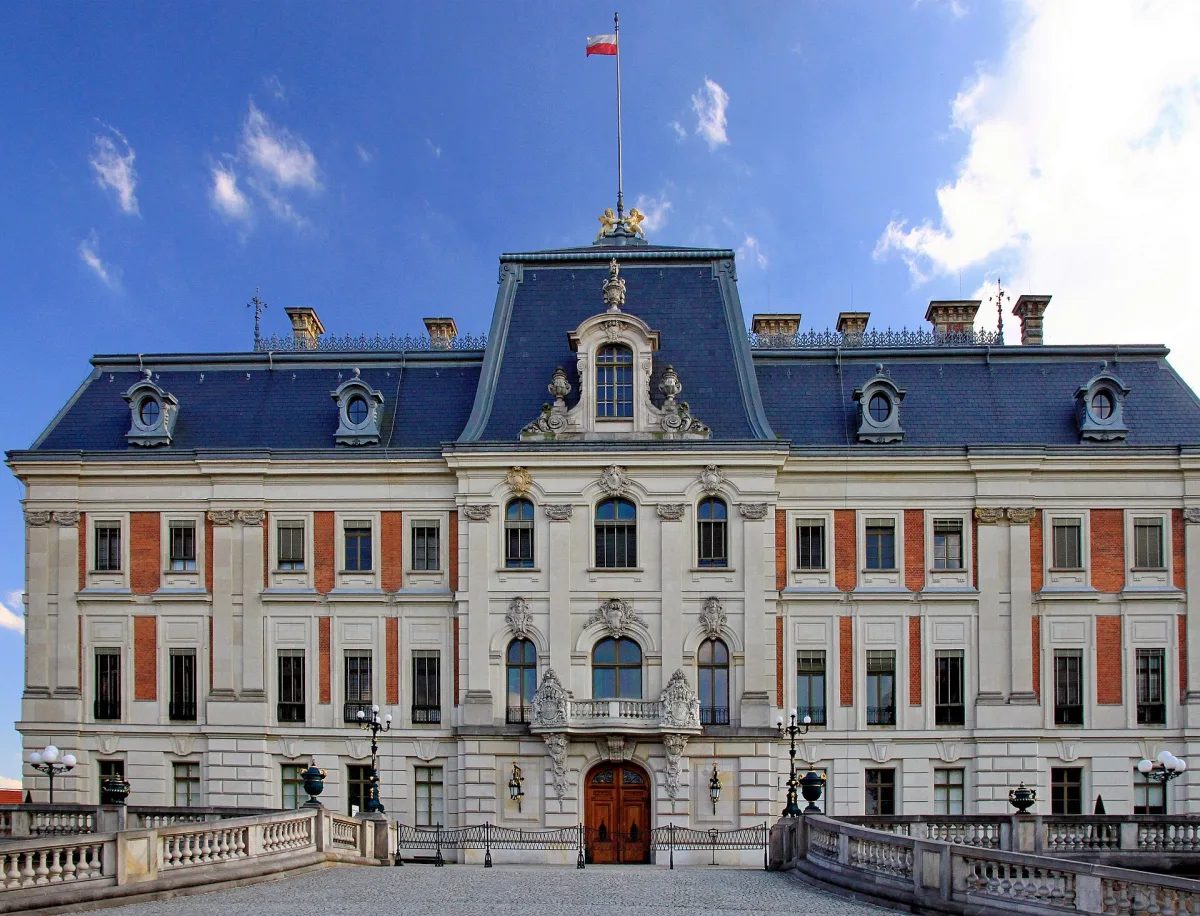
A former magnate residence, now the Castle Museum, with the original Hochberg interiors, the imperial apartment, the Mirror Hall and a historic park.
Pszczyna Castle is a former magnate residence, originally a Gothic castle from the early 15th century, now a palace housing the Castle Museum in Pszczyna. Together with the historic landscape park of 156 ha it forms a palace and park complex that was declared a Monument of History in April 2021. What sets it apart is the furnishing of its interiors: about 80 per cent is original.
The brick castle was built on the site of a former hunting lodge by Helena, wife of John II the Iron, Duke of Racibórz, who received Pszczyna for life use after their wedding in 1407. In 1548 the Pszczyna Land was bought by Baltasar von Promnitz, Bishop of Wrocław, and his family held the castle until 1765. In the second half of the 16th century the castle was rebuilt in the Renaissance style.
In 1687 the Gate of the Chosen (Brama Wybrańców) was built, the main entrance to the courtyard, guarded by soldiers chosen personally by the owner. In 1704-1707 the castle often hosted the composer Georg Philipp Telemann, and the musical tradition is continued to this day by the "Evenings with Telemann" concerts, held in Pszczyna since 1979.
The castle owes its present Neo-Baroque appearance to the rebuilding of 1870-1876 under the French architect Hippolyte Alexandre Destailleur. The façades were given the look of 17th-century French architecture, and an eight-metre mast with the owner's heraldic flag was placed on the roof. From 1847 the castle belonged to the Hochberg von Pless princes of Książ.
In 1891, in London, Mary Theresa Olivia Cornwallis-West, known as Daisy, married Hans Heinrich XV. Right next to the castle stands the Princess Daisy Bench in Pszczyna. In the history of the 20th century the castle is remembered for something else: in 1915-1916 it housed the Great Headquarters of the German army, where decisions were taken by Emperor Wilhelm II, Field Marshal Paul von Hindenburg and General Erich Ludendorff.
After the First World War and the incorporation of Pszczyna into Poland, the castle remained the property of the Hochbergs. After the Red Army took the town in February 1945, a front-line hospital was set up in it, which operated until 18 August 1945. Unlike many Silesian residences, its furnishings survived almost untouched, together with the chandeliers and large mirrors in the Mirror Hall.
The museum was opened on 9 May 1946. After a general renovation begun in 1995, the interiors from the Hochberg era were recreated. On the ground floor you can visit the reconstructed imperial apartment of Wilhelm II, with a council room, a study and bedrooms. The staircase, with three-flight stairs of light sandstone, refers to the Queen's Staircase at Versailles.
On the first floor there are, among other things, a library with walnut panelling designed by Destailleur and the salon of Princess Daisy, which is viewed through an open door. The second floor is occupied by a hunting gallery, where a stuffed bison named "Kader" is on display, which also appears in Filip Bajon's film "Magnat". The music salon contains a piano from Głogówek on which Beethoven is said to have played.
The Gothic cellars house the Armoury, opened in 2006. It displays weapons and armour from the 16th to the early 20th century, including executioners' swords and samurai armour.
About 700 m from the castle is the Pszczyna Village Farmstead.
The Anhalt-Köthen-Pless princes built the Bażantarnia palace in Poręba, now known as the Princely Pheasantry in Poręba, about 3.7 km from the castle.

Be the first! Add a comment.
You need to log in to add a comment.
Log in