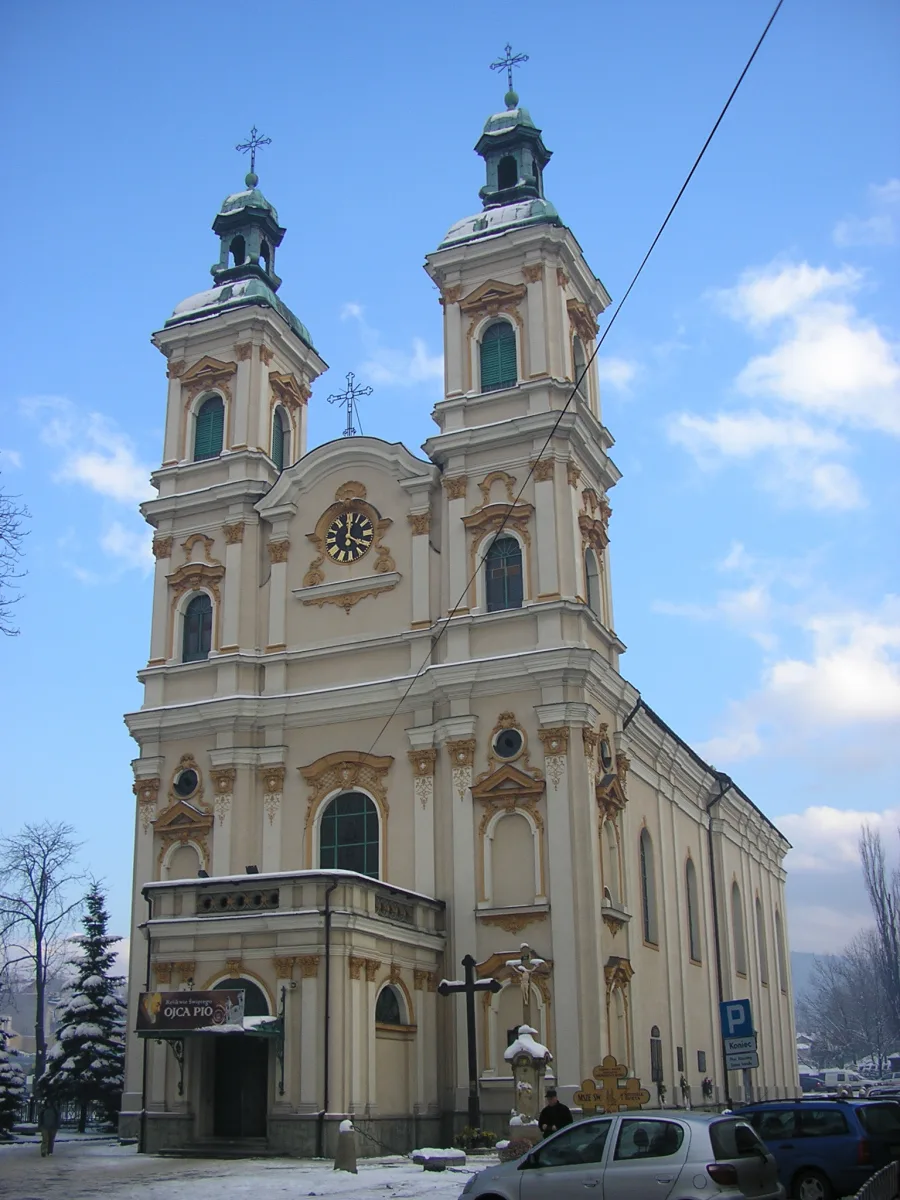
Late Baroque church of 1760-1769 in Biała Krakowska, rebuilt in the 19th century, with a Rococo pulpit and an organ of 40 stops.
The Church of Divine Providence is a historic church in the Biała Krakowska district of Bielsko-Biała, on Opatrzności Bożej Square. It was built in the Late Baroque style in 1760-1769 and was rebuilt twice in the 19th century. It still shows clear influences of Austrian Neo-Baroque and has interesting Rococo furnishings.
In 1708 Baltazar Damek, the first mayor of Biała and a wealthy linen merchant, founded a chapel dedicated to Divine Providence on this spot, along with a confraternity of the same name. It stood where he had earlier set up a cross after miraculously escaping death at the hands of a Swedish soldier. The present church was built in 1760-1769 by Gotfryd Berger and Jan Fieber to a design by Jan Józef Polaczek. It was funded by Count Alojzy Fryderyk Brühl, the starost of Lipnica, for the Jesuit house in Biała, whose members were then running missions to convert the local Lutherans to Catholicism. Until the dissolution of the order in 1773 the church's patron was St Ignatius of Loyola; it was then given its present dedication. The parish was established in 1789 and the church was consecrated in 1792.
The church originally consisted of a square nave with two small towers. In 1849-1850 a second part of the nave, side galleries and a chancel were added. Its present appearance comes from the rebuilding of 1886-1887 to a design by Emanuel Rost: the towers were raised, the choir loft was widened and the façade was altered, gaining a tower clock. The rebuilt church was consecrated in 1889 by the Bishop of Kraków, Albin Dunajewski, and in 1894 a Garden of Gethsemane (ogrójec) was added on the north side. Until the end of the 19th century Mass was held here in German, and at the beginning of the 20th century there were disputes over the language of services and inscriptions.
The furnishings date mainly from the second half of the 18th century. The best known is the Rococo pulpit in the shape of St Peter's boat sailing under the sign of the cross, with Jonah in the mouth of the fish, and the font with a scene of the baptism of Jesus in the Jordan. The wooden Neo-Baroque high altar from the mid-19th century is decorated with a painting of the Miracle of the Loaves. The Stations of the Cross of 1869 were painted by the Slovak painter Peter Michal Bohúň, who lived in Biała. The stained-glass windows with figures of the apostles date from 1894-1897. The organ was built in 1887 by the Rieger brothers of Krnov; after later rebuilding it has 40 stops and three manuals.
The south façade carries four plaques, among them ones dedicated to John Paul II, to the soldiers of September 1939, to the Home Army (AK) and the National Armed Forces (NOW), and to residents of Bielsko murdered by the NKVD, who were held in the camps at Kozelsk, Ostashkov and Starobelsk.

Be the first! Add a comment.
You need to log in to add a comment.
Log in