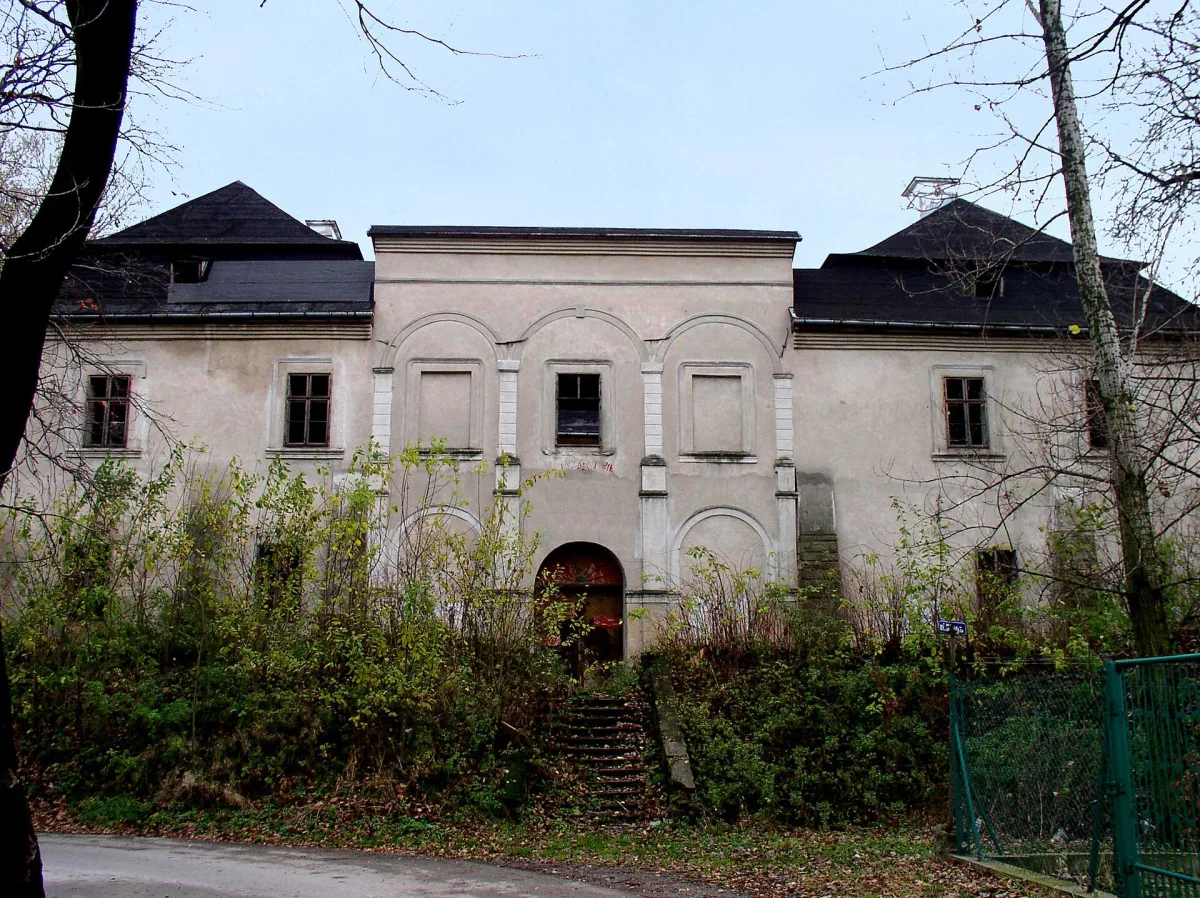
A brick fortified manor house in Czaniec from the early 17th century, with a defensive terrace and bastions, owned by the Habsburgs of Żywiec in 1822-1925.
The fortified manor house in Czaniec, in the Porąbka municipality, is a brick residence from the early 17th century, entered in the heritage register as early as 1934. The border between the Silesian and Lesser Poland voivodeships runs a few metres in front of its main entrance.
The first Renaissance manor was built in the early 17th century by the Dębowski family of the Kornicz coat of arms. In the middle of the century the Stokowski family rebuilt it into a palace and garden complex: they added a north wing with a chapel and a staircase, and galleries that formed a courtyard. In the 18th century the estate often changed owners. In 1822 the manor passed into the hands of the Habsburgs of Żywiec, who held it until 1925, when Karl Stephan Habsburg gave it, together with the farm, to the Polish Academy of Arts and Sciences. In the interwar period a conference centre operated here. After the war the manor was occupied by inhabitants of the surrounding villages, and later it stood empty and fell into ruin. Since 2008 it has belonged to a private investor, who replaced the roof and the plaster.
This is a two-storey manor with two residential wings and a small courtyard. The front of the courtyard is closed by an arcaded gallery. The whole is surrounded by a rectangular defensive terrace with corner bastions. On the ground floor is a chapel with Early Baroque stuccowork, and a long avenue with old trees leads to the manor. The garden was entered in the heritage register in 2020.

Be the first! Add a comment.
You need to log in to add a comment.
Log in