
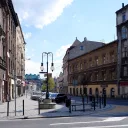
Former Lower Market Square of Bielsko, the cradle of the town's industry, surrounded by Art Nouveau townhouses from the turn of the 19th and 20th centuries.
Franciszek Smolka Square (Plac Franciszka Smolki) is the former Lower Market Square (Niederring), the main square of Bielsko's Lower Suburb, in the centre of Bielsko-Biała. It was here, on the Biała river and two mill races, that Bielsko's textile industry began.
In the 16th century the ruler of the Bielsko state founded a hospital and almshouse here with a wooden church of St Anne, which survived until the great fire of the town in 1808. The oldest manufactory, the dye works of Johann Christoph Ditzius, was established by the square in 1720. In 1836 nine industrial plants operated here, and the square also served as an exchange, from which it was named Börsenplatz.
When the factories moved further from the centre, Art Nouveau and neo-style townhouses took their place. The oldest surviving is the Halent townhouse from the 1870s. On Barlickiego Street stands an Art Nouveau building from 1900 designed by Max Fabiani, the former seat of the Savings Bank, with a Viennese café on the upper floor and ceiling polychromes by Rudolf Glücklich. Next to it, in a complex from 1909-1910, runs an arcade connecting Smolka Square with Bolesław Chrobry Square.
The name was given after 1918, after the Galician politician Franciszek Smolka. In 1973 a bridge was built over the Biała, connecting the square with Stojałowskiego Street. On this occasion the buildings of Nad Ścieżką Street were demolished, including the townhouse with the Neve Shalom synagogue, which operated here in 1870-1939. The square covers about 1,500 square metres, and most of it is taken up by roadways and a car park.

Be the first! Add a comment.
You need to log in to add a comment.
Log in