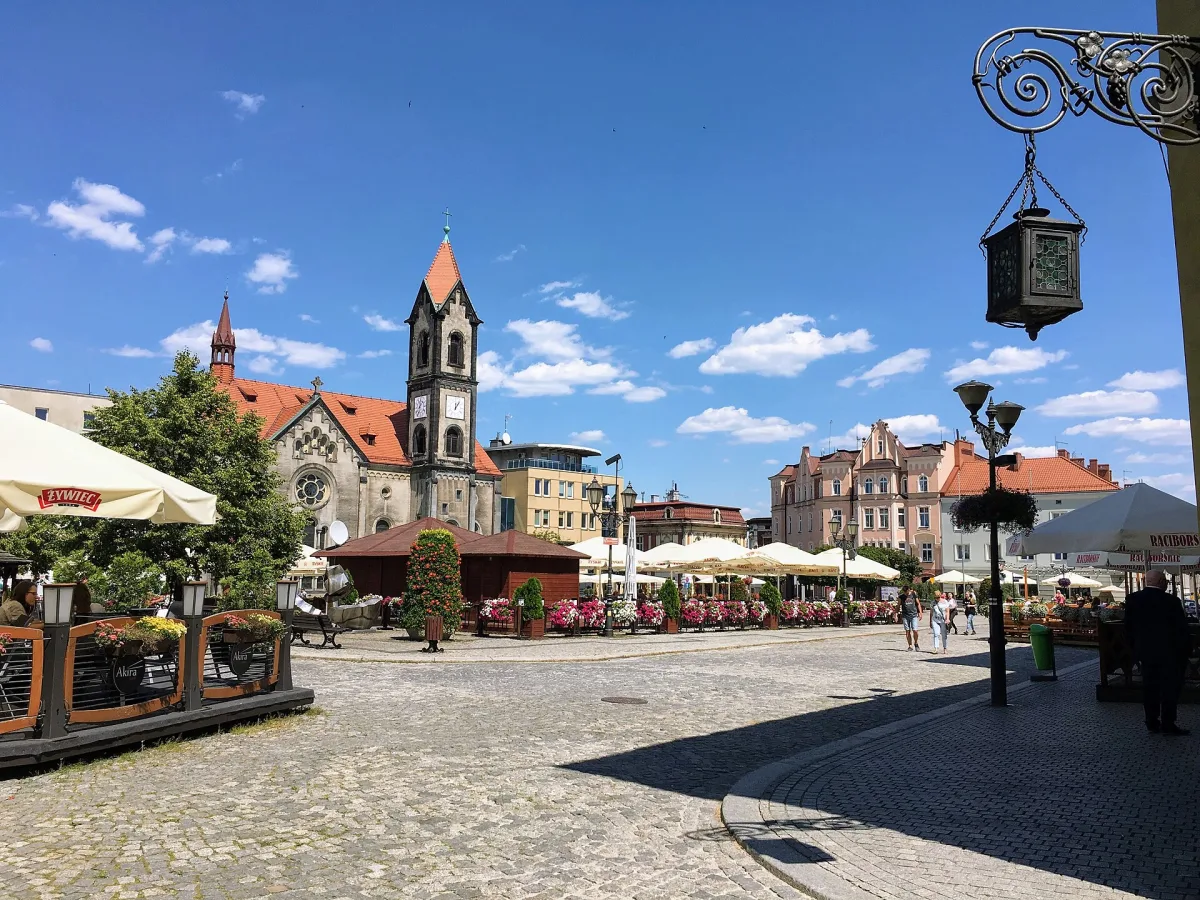
The main square of Tarnowskie Góry, with 16th-century miners' houses and a town hall from the late 19th century.
The Market Square (Rynek) in Tarnowskie Góry is a trapezoidal square 108 m long, surrounded by 16th and 17th-century gwarek (mine-owner) houses, a town hall of 1896-1898 and townhouses with arcades. It is the main square of a town that grew out of ore mining.
The first market square was today's Plac Gwarków, but the rapid growth of the town meant that a new, main square was laid out. In 1548 it was widened to the east. It housed the Mining Office, the court, the starost's office of the Bytom land and the town council, and the richest burghers, the gwarks, built townhouses around it. The square has the shape of a trapezium 75 m wide in the western part and 52 m in the eastern part. The irregularity comes from the fact that mining work went on even in the very centre of the town, and the gwarks built houses next to the shafts, not in any set order.
In the west stands a wooden well windlass on a stone base, from the 1950s, recreated from old engravings; around it a fragment of the 19th-century paving has been preserved. On the square there is also a monument to the lump of ore extracted in the 15th century by the peasant Rybka, and in 2015 a sculpture of a miner was unveiled by the arcades. A cross from 1858 commemorates the founding of the town by Duke John of Opole and Margrave George of Hohenzollern. At the turn of 2020 and 2021 the eastern part of the square was rebuilt, with benches, planters and a street drinking fountain added.
A few hundred metres from the square the underground mining world begins: the Silver Mine in Tarnowskie Góry and the Royal Frederick Mine. The synagogue is also nearby.

Be the first! Add a comment.
You need to log in to add a comment.
Log in