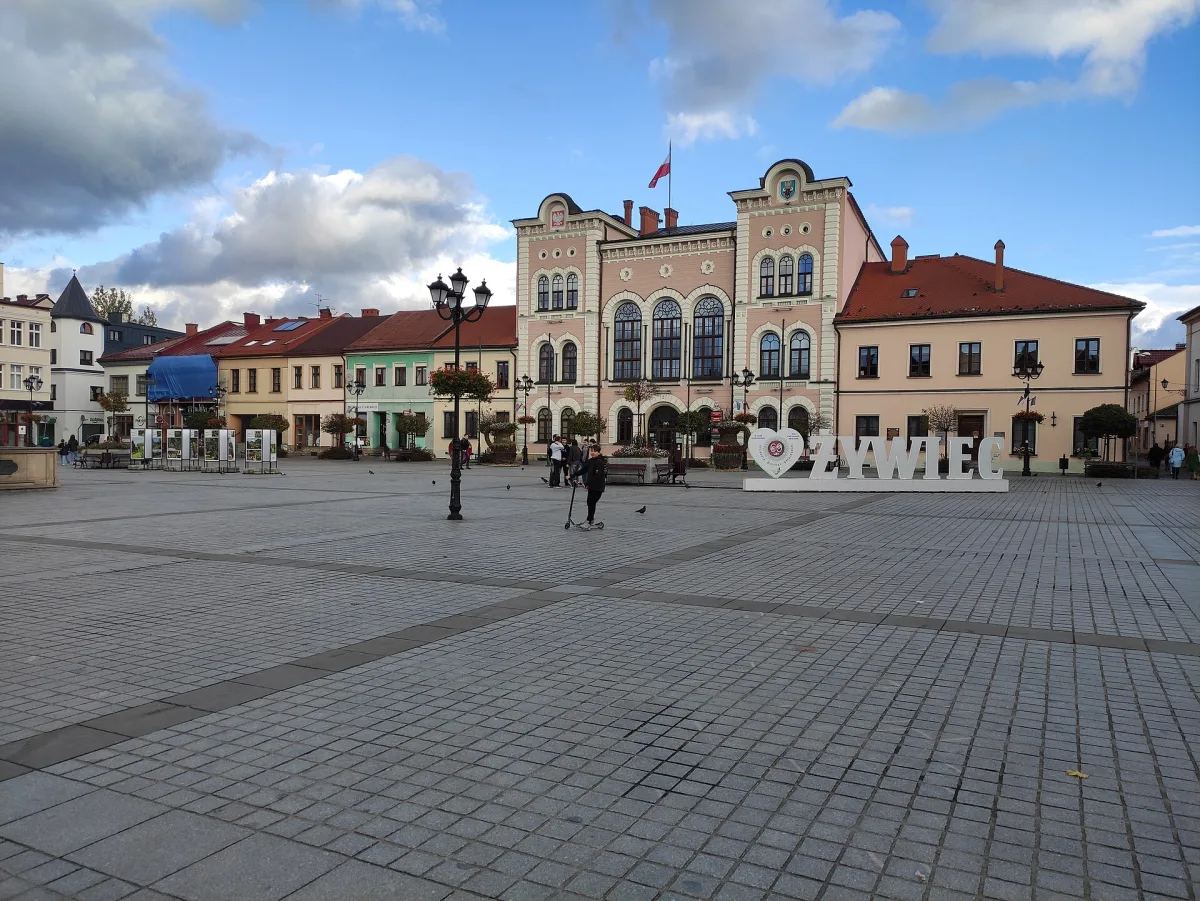
A medieval chartered square in Żywiec with tenement houses, the Town Hall and the co-cathedral, laid out in the 15th century.
The Market Square (Rynek) in Żywiec is a medieval chartered square, probably laid out in the first half of the 15th century at the foot of Grojec hill. It has a regular, four-sided shape, and beside it stand tenement houses and the Town Hall (Magistrat). The market square itself is not a separate monument in the register, but it belongs to the protected urban layout of the town, and 23 historic buildings stand around the square.
Some of the residents of Stary Żywiec, plagued by floods of the Soła, moved in the 15th century to the area of Grojec hill, about two kilometres to the south. The new town was chartered on a greenfield site and a regular market square was laid out. On the southern frontage a cemetery was established, and a wooden bell tower and a church were built, the first stone structure in the area.
Żywiec lay on trade routes towards Orava, Moravia, Bielsko and Kraków. The first two fairs were established here in 1518 by Sigismund the Old, and in time about twelve fairs a year were held on the market square. From the early 18th century executions were also carried out on it.
The buildings were repeatedly destroyed by fires: in 1711 the parish church burned down after a lightning strike, in 1721 a fire destroyed a considerable part of the buildings together with the wooden bell tower, which was rebuilt in stone, and further fires broke out in 1830 and 1857. In 1813 a flood was so violent that people moved around the market square by boat. After the fire of 1857 stone building became common, and in 1868 the town council moved into the newly built Town Hall. Beside the square stand the historic bell tower and the Co-Cathedral of the Nativity of the Blessed Virgin Mary.
After the outbreak of the First World War a detachment of about seven hundred volunteers set out from the market square for the eastern front. In 1916 the Act of the Two Emperors was proclaimed here, and in February 1918 a large protest by Poles against the partitioning power took place. In 1938 the market square was renamed Józef Piłsudski Square. During the occupation the Germans destroyed the statue of St Florian that had stood here since the 19th century, and in the communist period the square was called Unity Square. In 1967 the surface of the market square was renovated and lowered by about 40 centimetres. In 1995 a meeting of residents with John Paul II took place on the market square.
From the market square it is easy to reach the Municipal Museum in Żywiec, about 300 metres away. About 200 metres from the square is the Miniature Park in Żywiec, and the walk can be finished at the Bench of Alice Habsburg.

Be the first! Add a comment.
You need to log in to add a comment.
Log in