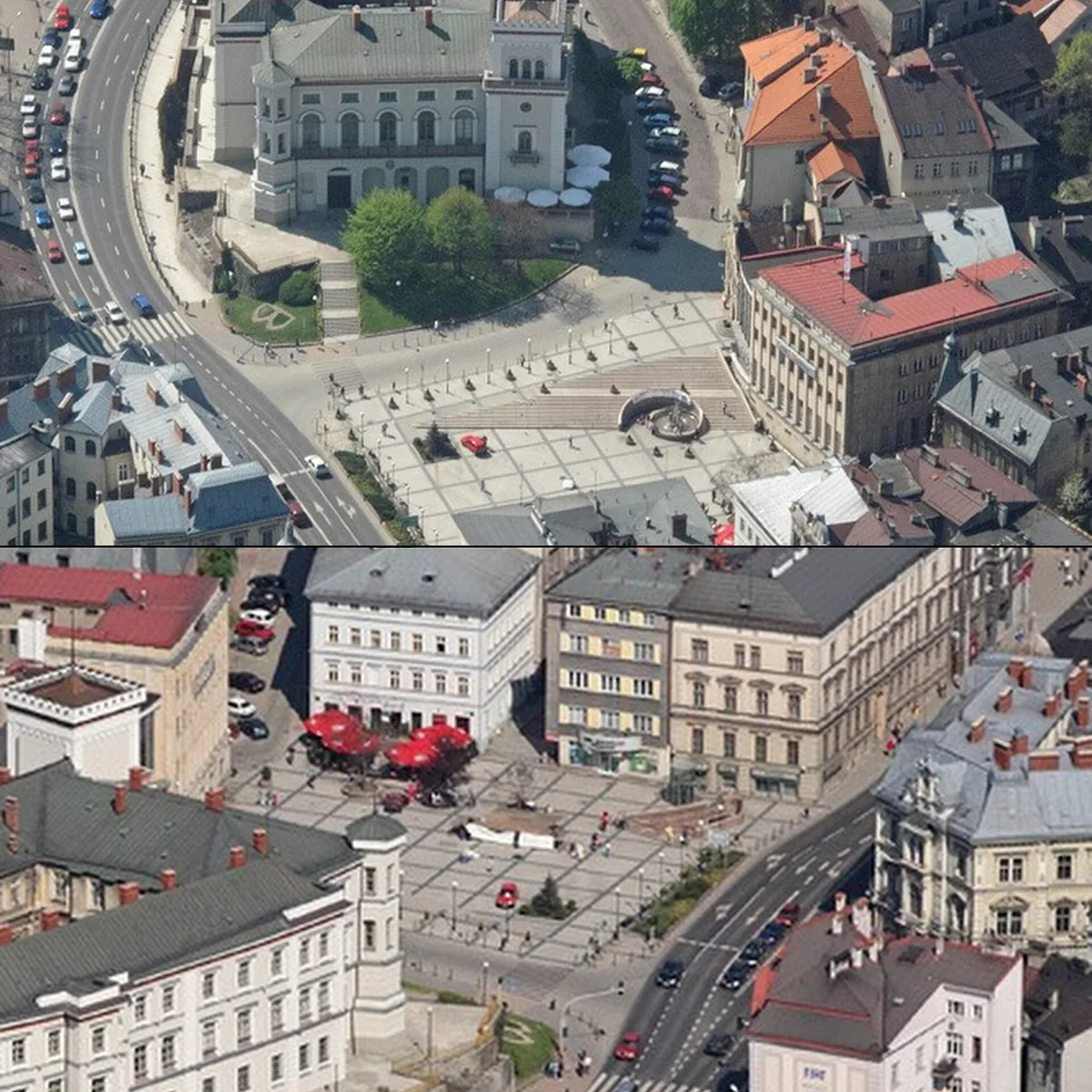
The central square of Bielsko-Biała, with a fountain on a pink paved area and the Sułkowski castle in the background.
Plac Bolesława Chrobrego (Bolesław the Brave Square) in Bielsko-Biała is the central point of the town and its most important public space, popularly called Pigal. It lies in the town centre, in the historic Dolne Przedmieście (Lower Suburb). Its dominant feature is the castle of the Sułkowski princes closing it from the south, and the rest of the frontage is made up of Baroque, historicist and Modernist townhouses and a Modernist bank building.
The square is almost square in shape, measuring 60 by 60 m, with an area of 3,600 m². The pedestrianised paved area has a surface of grey granite interspersed with black basalt, laid in a grid. In the western part stands a fountain with a sculpture of three naked boys, by Mieczysław Hańderek, from the end of the 1970s. The wide steps on the eastern side of the fountain can serve as an audience area for open-air events. The present paved area with the fountain as its focal point was designed by Marek Gronner and Paweł Rączka, and the work was completed in 2003.
The square began to take shape in the mid-19th century. Originally it was called Pechring, that is Plac Smolny (Tar Square), from 1890 Töpferplatz, and it has borne its present name since 1925. When the Niper mill race was channelled underground after 1863, and a grand avenue to the new railway station was laid out in the second half of the century (today's ul. 3 Maja), the square became the centre of the town and competed with the Old Town market square. Under the square runs a railway tunnel of 1874. In 1976 the car park and the bus stop were removed, and the square was turned into a pedestrian zone.
The castle was built in the 14th century at the initiative of Duke Przemysław I Noszak of Cieszyn, and the last rebuilding in 1855-1864 gave it an eclectic façade facing the square. Today it houses the Historical Museum in Bielsko-Biała. On the western side stands the Baroque Kałuża townhouse from the second half of the 18th century, the only remnant of the former buildings of the square, and next to it the Modernist building of the former Municipal Savings Bank of 1938, designed by Paweł Juraszko, with a stained-glass window showing a panorama of the town. In the north are the "Mimoza" café and the "Delicje" patisserie in Hermann Lindner's townhouse of 1884, and in the corner Patria townhouse, from 1889, the interior has been kept in the Neo-Rococo and Art Nouveau style.

Be the first! Add a comment.
You need to log in to add a comment.
Log in