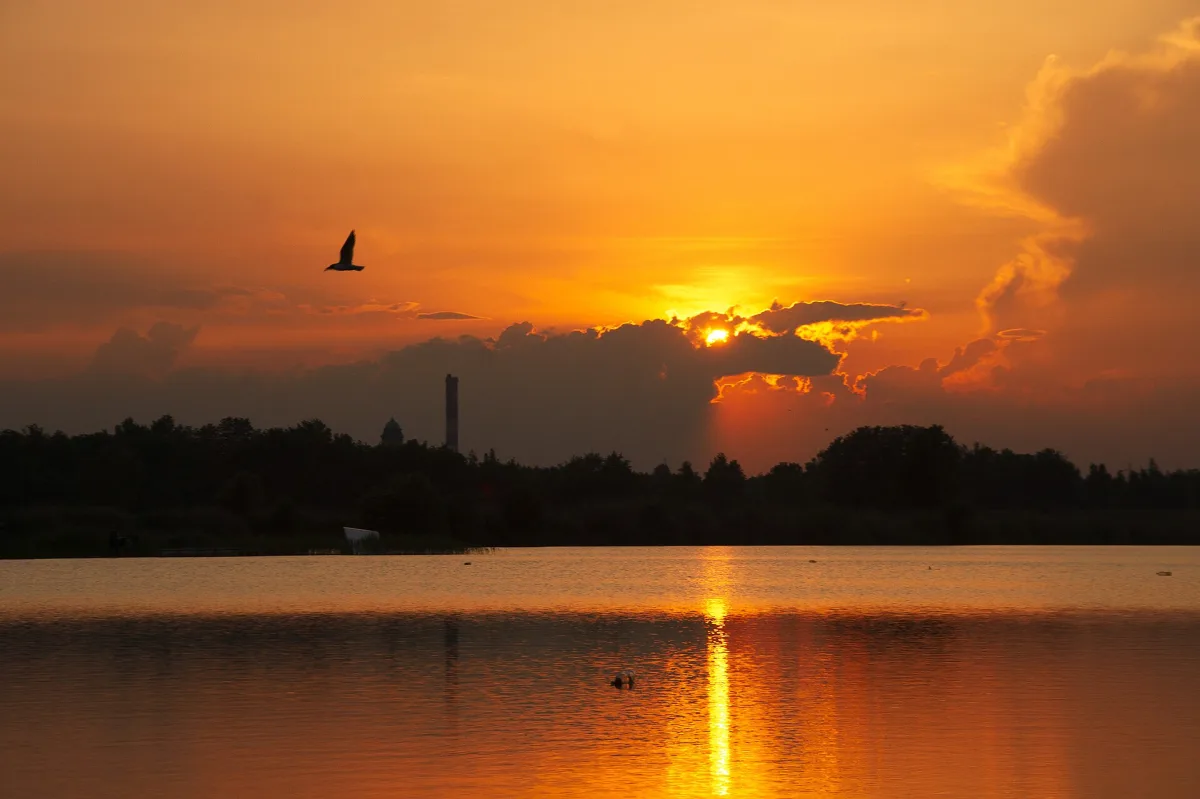
A complex of ponds on former sand pits in Szopienice, on the border of Katowice, Sosnowiec and Mysłowice, with a breeding colony of black-headed gulls.
The “Szopienice-Borki” nature and landscape complex is a group of ponds in the north-eastern part of Katowice, established in 2000. It covers about 157 ha out of some 200 ha of ponds and their surroundings in the lower stretches of the Brynica and Rawa valleys, within the boundaries of Katowice, Sosnowiec and Mysłowice.
The ponds formed on the sites of former sand pits, where sand was dredged for the needs of mining, and in hollows left by underground extraction. Coal was mined in this area until the beginning of the second half of the 20th century. The complex includes the ponds Morawa, Borki and Hubertus, and Stawiki in Sosnowiec.
Borki is one of the smaller ponds, with an area of 9 ha and dimensions of about 700 by 100 m. It is little developed, and on the southern and northern banks there are wild beaches. Morawa is the largest and youngest: it covers about 35 ha and was formed in the 1960s. Residents of Szopienice called it Bagier, from dredging. In the south-eastern part of the pond a beach, an outdoor gym and the boat harbour of the 10th Scout Sailing Troop named after Mariusz Zaruski have been set up.
Hubertus is a group of ponds: a large one, divided by dykes into three parts, and a smaller Hubertus IV with an area of 7 ha, lying in Mysłowice. Most of them serve as angling waters. According to the description of the complex, Hubertus III in the Mysłowice part has a town beach and a wakeboarding lift.
The complex is a refuge for plants and animals, mainly waterfowl. The banks are overgrown with reedbeds, in which, among other things, the rare marsh helleborine grows. In the water live a dozen or so species of fish, among them roach, pike and bream. Around the ponds the European rhinoceros beetle occurs, one of the largest beetles in Europe.
The breeding colony of black-headed gulls here is the largest in the Katowice agglomeration: in 1993 it numbered 350 nests. Great crested grebe, mute swan, coot and reed warbler also breed here, while mute swan, mallard and common gull winter here.
Nearby is the Walcownia, the zinc metallurgy museum (Zinc Rolling Mill).

Be the first! Add a comment.
You need to log in to add a comment.
Log in