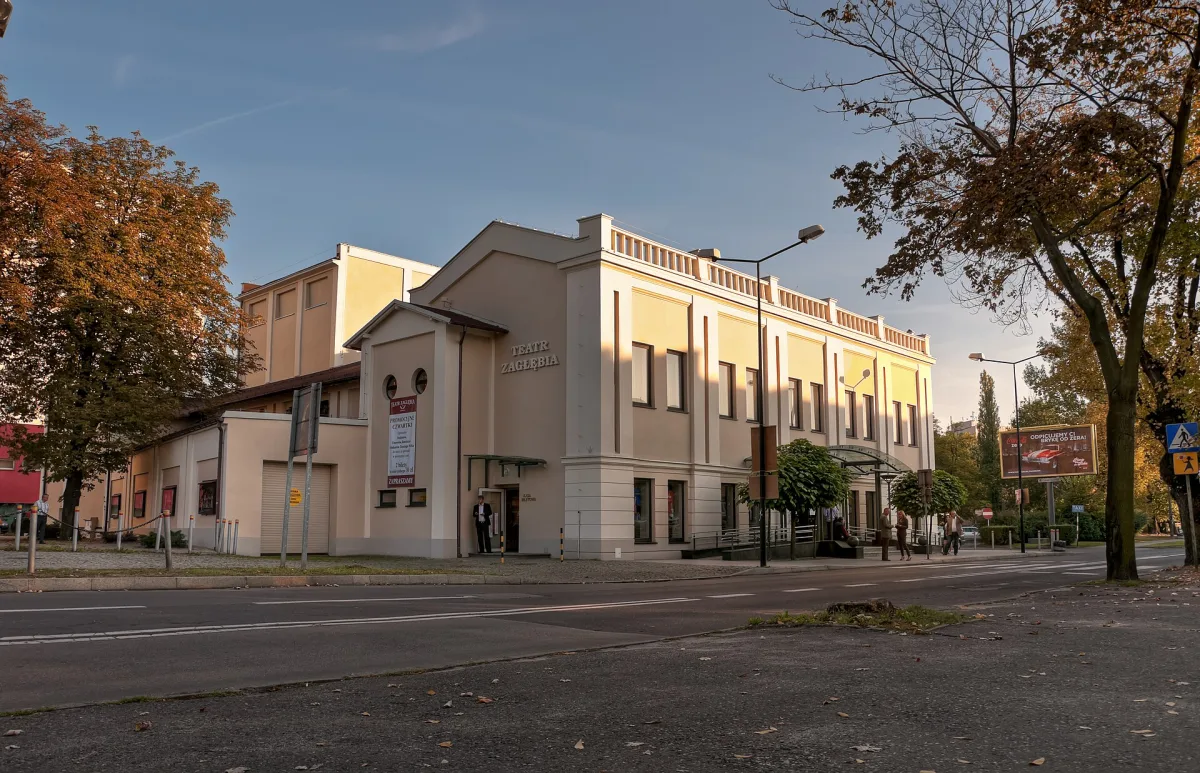
A historic theatre in Sosnowiec, opened on 6 February 1897 as the Winter Theatre, designed by Karol Steczkowski, with an amphitheatre-style auditorium and paintings by Rudolf Sarbiewski.
The Zagłębie Theatre (Teatr Zagłębia) stands on Teatralna Street in Sosnowiec, a few hundred metres from the cathedral basilica. It was opened on 6 February 1897 as the Winter Theatre and is considered the sixth permanent stage in the Polish lands, after Warsaw, Kraków, Lviv, Lublin and Kalisz. The building is entered in the heritage register.
Before the building was erected, amateur theatres had operated in Sosnowiec since the 1870s, among them among workers and railwaymen. The construction was initiated by the entrepreneur Józef Szymański and supported financially by the “Hrabia Renard” mining company, led by Ludwik Mauve. In 1896-1897 a complex was built: the Winter Theatre, the Hotel Saski and the wooden Summer Theatre, which stood in the nearby park and was pulled down during the First World War. The first director was Czesław Teofil Janowski, who brought his own company. For the opening, “Zemsta” (The Revenge) by Aleksander Fredro was staged, with a prologue by Andrzej Niemojewski.
On 24 November 1905 a general strike was declared in the building, and during the First World War the “Wiktoria” cinema operated here. In 1924 the theatre passed into public ownership. On the night of 17-18 January 1939 a fire destroyed the stage, the attic and part of the roof; the repairs took seven weeks. After 1948 the stage became part of the United Silesian-Dąbrowa Theatres, and on 1 July 1955 it regained its independence as the State Zagłębie Theatre, opened with Fredro's “Śluby panieńskie” (Maidens' Vows).
The author of the design was Karol Steczkowski, and the construction was supervised by Stanisław Trembiński, an architect of the Warsaw railway. The style is historicism with neoclassical and neo-Renaissance elements. Originally the building had one upper floor, with a rectangular front part and a perpendicular part housing the auditorium and stage, for about 700-800 spectators. The ground-floor auditorium was designed as an amphitheatre, with eight six-person boxes and a gallery. The paintings, including the cupids on the ceiling and the portraits of Słowacki, Bogusławski, Moniuszko, Fredro and others on the balconies, were made by Rudolf Sarbiewski. The building has kept its basic 19th-century layout: the front part, the auditorium and the stage, although it was rebuilt many times in the 20th century, among others in 1976-1978 and 2008.
The theatre has been awarded Golden Masks several times, among others for “Kordian” directed by Zbigniew Zasadny and for the performance “Korzeniec”. It runs the “Accessible Stage” series with audio description, subtitles and interpreting into Polish Sign Language. An extension with a large stage and a black box hall is planned, so check the state of the work before your visit.
Not far away lies Sielec Park, and around the centre are Park Harcerski and Stawiki.


Be the first! Add a comment.
You need to log in to add a comment.
Log in