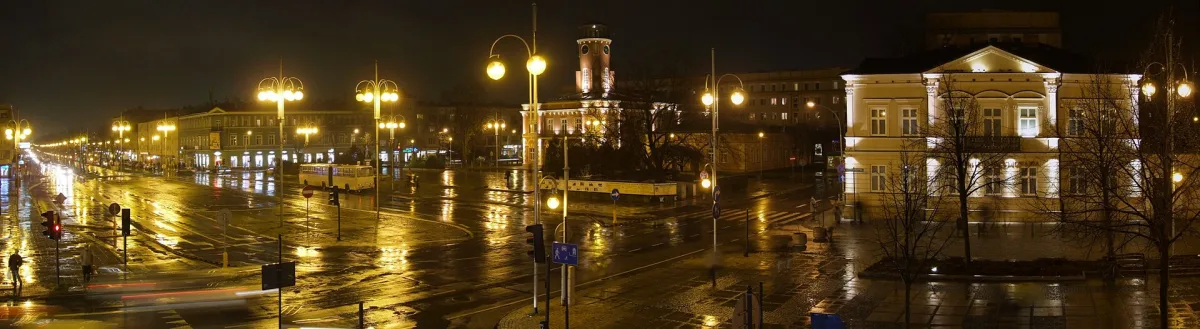
A square in central Częstochowa on the pilgrim route to Jasna Góra, with a town hall from 1828-1836 and St James's Church.
Władysław Biegański Square is one of the squares in the central district of Częstochowa, on the pilgrim route to Jasna Góra. It divides Aleja Najświętszej Maryi Panny into the so-called Second Avenue to the east of the square and the Third Avenue to the west of it.
The town hall stands in the southern part of the square. It was built in 1828-1836 to a design by Franciszek Reinstein, halfway between Stara and Nowa Częstochowa, and was rebuilt in 1908. It is a late Neoclassical two-storey building with a round two-tier tower. It was the seat of the city authorities until the 1960s, and today, together with the guardhouse, it belongs to the Częstochowa Museum.
In the northern part of the square, in the middle of a tree-lined green, stands the Church of St James the Apostle. A church with this dedication stood here from the 16th century, next to a shelter for sick pilgrims. After the January Uprising it was pulled down by the Russian authorities, and in 1870-1872 an Orthodox church of Saints Cyril and Methodius was built on its site. In 1918 it was turned into a Roman Catholic church with its old dedication restored. Although the onion domes were removed in 1948, the building still refers to the Russo-Byzantine style. It has a separate entry: St James's Church in Częstochowa.
The square was originally called St James's Market Square (Rynek św. Jakuba). In the 1930s it bore the name of Bronisław Pieracki Square, during the occupation it was Westring, and in the Stalin era Joseph Stalin Square. The present name has been in use since 1956. Since 11 November 1997 a monument to Marshal Józef Piłsudski has stood in front of the town hall, on the spot where a monument of gratitude to the Soviet Army had stood before.
In 2011 the square was rebuilt, and the roads cutting across it on the east-west axis disappeared from its centre.


Be the first! Add a comment.
You need to log in to add a comment.
Log in