Cemeteries and monuments in Ligota-Panewniki, a Katowice district: the Panewnicka Street necropolis, a defenders' memorial and a composer's bench.
The five places gather around the Franciscan monastery in the Katowice district of Ligota-Panewniki. There is one necropolis, two monuments tied to the friars and the Servant Sisters, a memorial to the events of 1939 and a bench for a composer. All stand in public space or on cemetery grounds.
What is at the cemetery on Panewnicka Street?
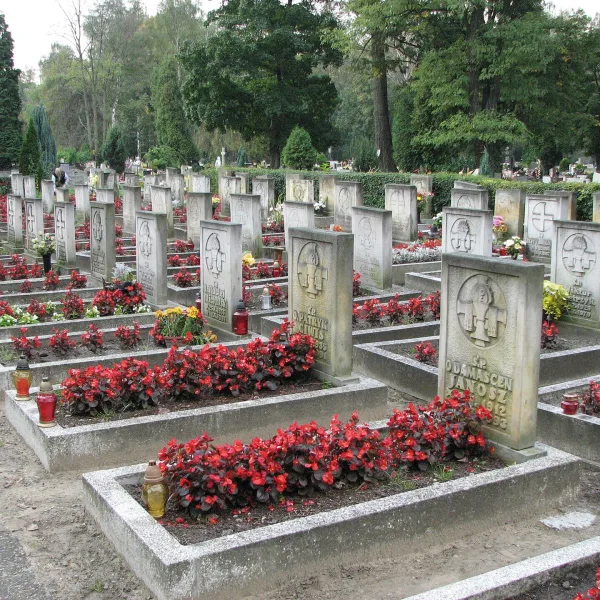
The municipal cemetery at number 45 faces the Franciscan basilica and shares its history. The friars have their own plots here.
The first brothers were laid to rest in the new necropolis in 1911, and the formal consecration took place on 23 January 1914. The founder and benefactor was Nepomucen Wielebski, head of the municipality. The administrator describes it as a historic cemetery typical of the region, where present-day burials happen mostly in the family graves of several generations.
A memorial to the Defenders of Katowice was set up on its grounds. Its inscription speaks of the ashes of Silesian insurgents and of scouts murdered in September 1939 in the Panewniki woods, in prisons and on the city's streets. Defenders of Katowice were buried here as well, one hundred and five people in all. The bodies were laid down in secret at first and exhumed after the war. The place calls for quiet.
Which monuments stand next to the basilica in Panewniki?
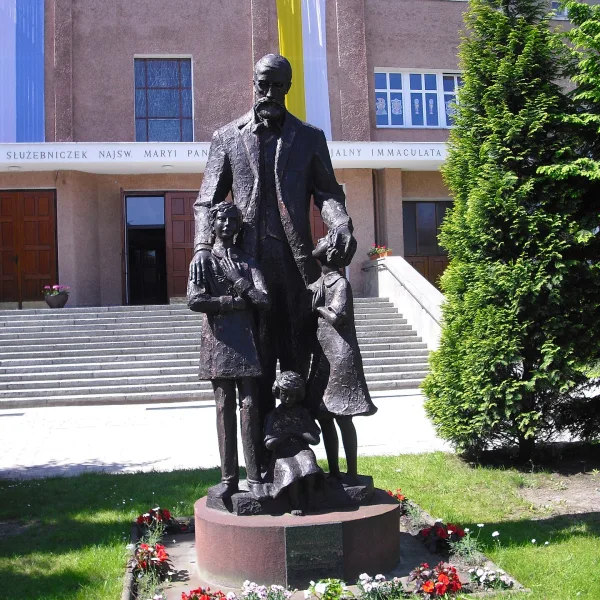
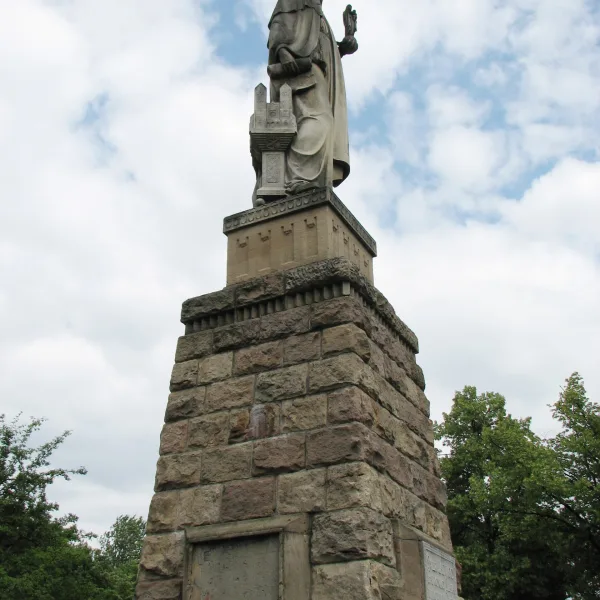
Beside the Franciscan basilica stand the monument to St Hedwig of Silesia on Klasztorny Square and the monument to Edmund Bojanowski at Panewnicka 63.
Hedwig's figure was unveiled on 21 July 1912. Bruno Tschötschel carved it in sandstone, and the Franciscan Meinard Wieczorek designed the plinth with its arcade frieze. The saint carries a model of the Panewniki basilica in one hand and a small Madonna and Child in the other, and Silesian eagles appear on her cloak and cord. The sculpture before the Servant Sisters' convent shows Bojanowski with three children, one sitting at his feet. Sister Czesława Marek of the congregation designed it. The basilica rises next door.
Whom does the bench on Szabelski Square commemorate?
The Bolesław Szabelski Bench recalls the composer who lived in Ligota at Wileńska 21 from 1945 to 1956. It stands on the square bearing his name, where Piotrowicka and Panewnicka streets meet.
The marble and bronze bench with its bust, unveiled in 2019, is the work of Bogumił Burzyński. The idea went into the Katowice civic budget in 2018 and was funded by residents' votes. The square received the composer's name in 2010. The district also has churches and monasteries in Ligota-Panewniki, and the wider picture of the region comes from the category cemeteries and monuments in Silesia. The full district set is under Ligota-Panewniki.
Frequently asked questions
Where is the cemetery in Ligota-Panewniki?
At Panewnicka 45 in Katowice, opposite the Franciscan basilica.
Whom does the Monument to the Defenders of Katowice honour?
Insurgents of Silesia, scouts killed in 1939, and the town defenders laid to rest there.
When was the St Hedwig statue unveiled?
On 21 July 1912. The figure stands on Klasztorny Square, by the basilica.
Who paid for the Szabelski bench?
Katowice residents, since the project won in the civic budget.

 Cemeteries and monuments