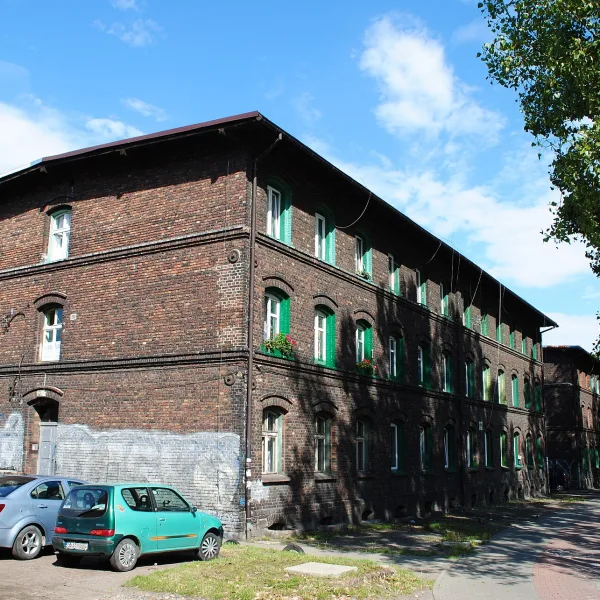
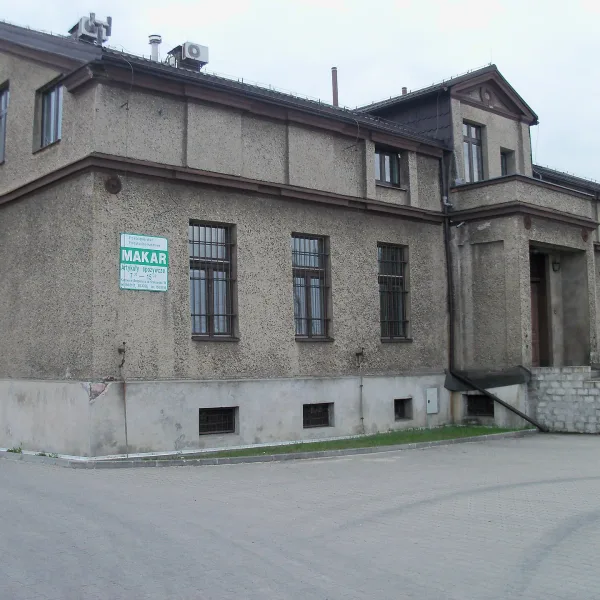
Industry and technology in Szopienice-Burowiec, Katowice: a water tower from 1912 and two workers' estates by the zinc works, Helgoland and Wilhelmina Colony.
This selection suits anyone who prefers to read the traces of industry in the street rather than in a museum. All three places are tied to the zinc works around which this part of Katowice grew.
What is left of the zinc works in Szopienice-Burowiec?
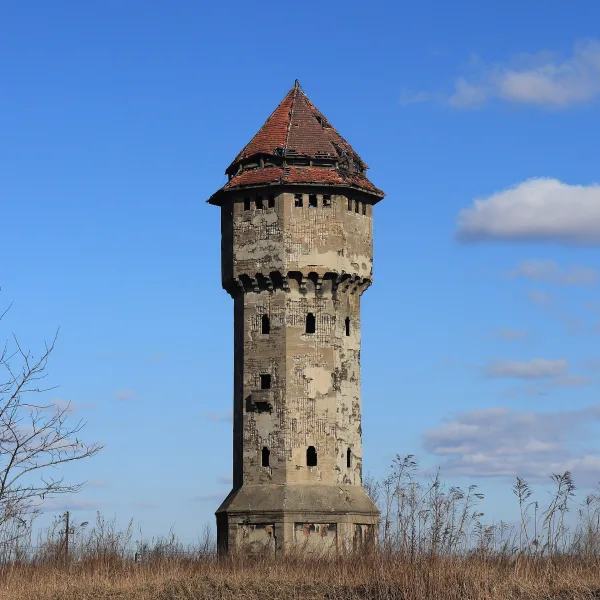
The most visible survivor is the Water Tower of the Szopienice Non-Ferrous Metals Works. The reinforced concrete structure from 1912 has been on the monuments register since 1978. It stands on the grounds of the former works and is no longer in use, so you can only see it from the outside.
Together with a second tower, it supplied the complex with industrial water drawn from an intake on the Brynica built for that purpose.
Where did the workers of the works live?
Helgoland is a brick estate along Lwowska Street, put up between about 1890 and 1905 in the historicist style. Its high escarpment recalled an island, hence the name, which maps already show in 1898.
Wilhelmina Colony is older. The first family houses, without running water or sewers, went up from 1846, and homes from the 1870s still stand on Krakowska Street, together with a former small palace. The zinc works was founded here in 1834.
For a wider picture, browse the category industry and technology, and nearby you will also find the monuments of the district.
Frequently asked questions
Is the Szopienice water tower open to visitors?
No, the tower is out of use. You can look at it from the outside, from the area of the former zinc works.
Where does the name Helgoland come from?
The estate sits on a steep rise and was likened to the island of that name. Maps carry the name as early as 1898.

 Industrial heritage