Architecture in Sosnowiec means factory owners' palaces, red-brick churches and the old station that gave the city its start. See what to visit first.
Sosnowiec grew fast on industry and the railway, and its buildings show it. This guide is for visitors who want to see palaces, churches and industrial buildings in a day and understand who built them and why. For a general overview of the city's monuments, see things to do in Sosnowiec, and for the wider region see architecture in Silesia.
Which palaces in Sosnowiec come first on a route?
Begin with the palaces of the Dietel and Schön families, because they show best what the wealth of industrialists looked like around 1900. They stand in several districts, so plan the order. The article on the palaces and mausoleum of the Sosnowiec industrialists tells more about both families.
Dietel Palace is a neo-Baroque residence at Stefana Żeromskiego 2a, listed in the register of monuments. Its ceremonial rooms and part of the original decoration have survived. Across the street stands the Lutheran church in Pogoń, a brick building with a clock tower that grew out of the chapel of the same factory.
Franz Schön Palace at 1 Maja 19 is eclectic and was built in 1900-1903 as the residence of a wool industrialist. In 1919 it housed the headquarters of the Silesian uprising, and today it is home to a district court, so you can only admire it from outside. The family's second palace, Wilhelm's Palace at Chemiczna 12/14, stands in Środula. Designed by Józef Pomian-Pomianowski and finished in 1900, it served chiefly as a guest house, and the broken roofline stands out.
An older layer of the city is represented by the Mieroszewski Manor House in Zagórze, a two-storey Neoclassical house with a surviving part of its park. The city's oldest structure is Sielecki Castle on the Czarna Przemsza, a former fortified manor remodelled twice, in 1620 and again in 1832. It is now the seat of the Sosnowiec Art Centre.
Which churches in Sosnowiec are worth a look?
The most interesting are the brick churches built during the city's rapid growth, and those with an unusual history.
The cathedral and the church by the station
The Cathedral Basilica of the Assumption of the Blessed Virgin Mary at Kościelna 1 is the main church of the Sosnowiec diocese. It was built in 1893-1899 to a design by the Warsaw architect Karol Kozłowski. Inside, the walls carry painted decoration in the Young Poland style by Włodzimierz Tetmajer and Henryk Uziembło, and outside a tall tower dominates the brick body. Next to the railway station stands the Church of the Sacred Heart of Jesus, a Neo-Gothic building from 1862. Locals call it the "railway church" since railway employees backed its construction. There is a park beside it with a grotto and a chapel of the Holy Sepulchre.
Neo-Gothic in Pogoń, Sielec, Niwka and Zagórze
The Church of St Thomas the Apostle on Orla Street in Pogoń was built in 1904-1911 to a design by Józef Pomian-Pomianowski. In Niwka, at Orląt Lwowskich 67, stands the Church of St John the Baptist, a Neo-Gothic pseudo-hall in bare red brick, whose bell tower reaches 65 metres. In Zagórze, at Popiełuszki 44, you will find the Church of St Joachim with two towers over 70 metres tall. The earlier single-nave church of 1848-1852 now serves as its porch.
Sielec has two churches because residents argued in 1902-1903 about where to put the new one. The Church of St Barbara is Neo-Gothic, from 1906-1907, its wall paintings renovated between 2009 and 2017. The Church of the Immaculate Conception on Skautów Street was under construction from 1905 to 1952, almost half a century. It is a three-nave red-brick church, and part of its furnishings came from the chapel of Sielecki Castle.
An Orthodox church and a former pithead hall
The Orthodox Church of Sts Faith, Hope, Love and their Mother Sophia on Kilińskiego Street, built in 1889, is the only one of the city's three former Orthodox churches that has survived. In Porąbka, the Church of Our Lady of Częstochowa was a pithead hall of the "Kazimierz" mine until 1924, and its interior recalls the district's mining past.
What industrial and urban architecture is left in Sosnowiec?
The station, a former bank and the buildings of a coal mine remain. All of them tell the story of a city created by a border and by coal.
The Sosnowiec Główny station at 3 Maja 16 is a Neoclassical building from 1859, listed in the register of monuments. It was a large border station with a customs hall, and goods traffic between Prussia and the Kingdom of Poland passed through Sosnowiec. In the centre, at Małachowskiego 3, stands the former Bank Handlowy. The older part of 1908, designed by an architect named Kugor, uses forms drawn from the Italian Renaissance, and an operations hall was added in 1923.
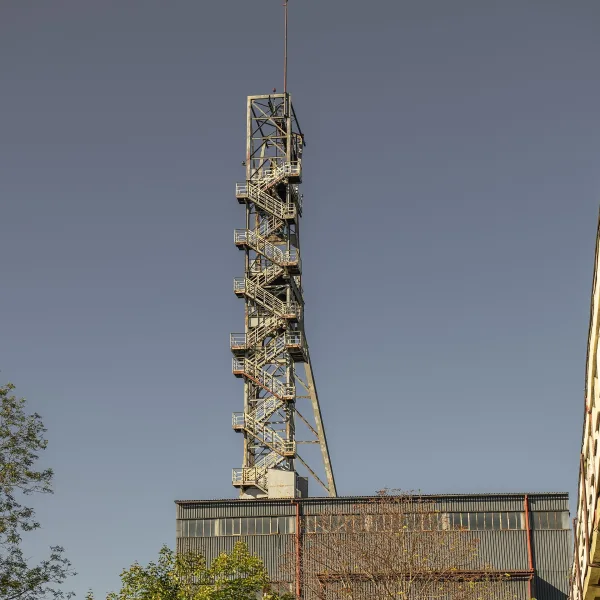
In Porąbka, on Grenadierów Street, lies the "Juliusz" mine complex. Construction began in 1902, and coal output started in 1914 after the "Juliusz" and "Karol" shafts were sunk. The buildings are in the register of historic sites and are best seen from outside. The church in the former "Kazimierz" pithead hall is in the same district, so the two pair well.
Where can you see tombstones and mausoleums in Sosnowiec?
The cemeteries on Smutna Street show funerary architecture of three faiths in a small area. They are active or war-damaged places, so visit quietly and with respect.
The Dietel family mausoleum of 1912 stands in the middle of the Lutheran cemetery and now serves as a cemetery chapel. The Lutheran cemetery is divided into seven sectors. Nearby lies the Orthodox cemetery, founded in 1894, covering 0.9 hectares and the only Orthodox burial ground across the Upper Silesian-Zagłębie Metropolis. The third, the Roman Catholic cemetery of 5.5 hectares, was consecrated in 1895 and has historic family tombs.
Three Jewish cemeteries recall the multicultural past of Zagłębie. The old cemetery in Modrzejów on Pastewna Street has about three hundred gravestones or fragments, the oldest dated 1790. The cemetery in Rudna kept about three hundred gravestones and a memorial to the murdered. The newest cemetery in Milowice, from the interwar years, has several dozen gravestones today. All three were damaged during the war. The historical background is described in an article on the ghettos in Będzin, Sosnowiec and Zawiercie.
How to plan a walk around Sosnowiec's monuments?
Pick one district at a time. Pogoń offers Dietel Palace, the Lutheran church and the Church of St Thomas, all around Żeromskiego and Orla streets. Sielec has the castle and two churches. The station area gives you the station and the railway church on 3 Maja Street. Środula is home to Wilhelm's Palace, and Porąbka to the "Juliusz" mine with the church in the former pithead hall. Leave the cemeteries on Smutna Street for a separate, quiet visit.
Frequently asked questions
Which monument is the oldest in Sosnowiec?
Sielecki Castle on the Czarna Przemsza is the oldest structure in town. It began as a fortified manor, was remodelled in the 17th and 19th centuries, and is now an art centre.
Can you go inside the palaces in Sosnowiec?
Not all of them are open to visitors. Franz Schön Palace houses a district court, so it is seen from outside. Dietel Palace has kept its ceremonial rooms, but check opening hours and entry rules before you go.
Where should you start sightseeing in Sosnowiec?
A good starting point is the Sosnowiec Główny station and the neighbouring Church of the Sacred Heart of Jesus. This is where the city began to grow after the station opened in 1859.
Are there industrial monuments in Sosnowiec?
Yes: the "Juliusz" mine complex in Porąbka from the early 20th century, and the former "Kazimierz" pithead hall converted into a church. The mine buildings are best viewed from outside.
How many historic cemeteries does Sosnowiec have?
Lutheran, Orthodox and Roman Catholic cemeteries lie on Smutna Street, and three Jewish cemeteries are in Modrzejów, Rudna and Milowice. Entry is free, but these are burial places, so keep quiet.

 Industrial heritage