Solo in Sosnowiec means manufacturers' palaces, university museums, historic churches and cycle trails, nearly thirty places to choose from.
Sosnowiec lies in the Dąbrowa Basin, and its history was largely built by industrialists, above all the Dietel and Schön families. Sightseeing alone makes sense here, because many places are small museums, single buildings and quiet districts.
What should you see in Sosnowiec alone if industrialists' history interests you?
Start with the palaces that recall the age of factories and great fortunes. The article on the palaces and mausoleum of the Dietel and Schön families helps in understanding who their founders were.
- The Dietel Palace, Żeromskiego 2a, is a Neo-Baroque home of a factory-owning family; its formal rooms have survived.
- The Franz Schön Palace at 1 Maja 19 was built in the early 20th century in the eclectic style. In 1919 the Silesian uprising was commanded from here; now a district court sits inside, so you view it from the street.
- Wilhelm's Palace at Chemiczna 12/14, built around 1900, served the Schön family as a guest palace.
- The Mieroszewski Manor House in Zagórze is a Neoclassical building designed by Franciszek Maria Lanci, surrounded by a part of the former park.
The manufacturers are also recalled by the Dietel family mausoleum, dating from 1912, made of volcanic tuff and used as a chapel; it stands in a Lutheran cemetery at Smutna 6. It is a burial place, so quiet is expected.
Which castle is the oldest, and what does it hold?
The Sielecki Castle at Zamkowa 2 is the oldest site in the city. Its site is the left bank of the Czarna Przemsza; the building was reworked in 1620 and in 1832, and the Sosnowiec Art Centre has its home there.
Which museums in Sosnowiec should you pick when it rains?
Four small museums receive lone visitors, and they differ greatly from each other.
Which churches in Sosnowiec are worth your attention?
The city has many churches, and each tells a different part of its story. The most imposing is the Cathedral Basilica of the Assumption: a brick cathedral of 1893-1899 at Kościelna 1, its interior painted in the Young Poland manner by Włodzimierz Tetmajer and Henryk Uziembło.
Other churches by district:
- in Pogoń, the Lutheran church, whose clock tower rises where the Dietel works chapel once stood, the Neo-Gothic Church of St Thomas the Apostle and the Mariavite church of 1910;
- in Sielec, the Church of St Barbara of 1906-1907 and the Church of the Immaculate Conception, whose construction lasted from 1905 to 1952;
- in Zagórze, the Church of St Joachim with two towers more than seventy metres high;
- in Niwka, the red-brick Church of St John the Baptist with a belfry tower sixty-five metres tall;
- in Maczki, the Church of Sts Peter and Paul, raised mainly with donations from railwaymen;
- in Porąbka, the Church of Our Lady of Częstochowa, converted in 1924 from a mine's lamp room;
- by the station, the Church of the Sacred Heart of Jesus of 1862, called the railway church, with a park and a grotto with a Lourdes statue.
A place of its own is the Orthodox church of 1889 on Kilińskiego street, the only one surviving of the three Orthodox churches of old Sosnowiec.
What else is there to see in the centre and the districts?
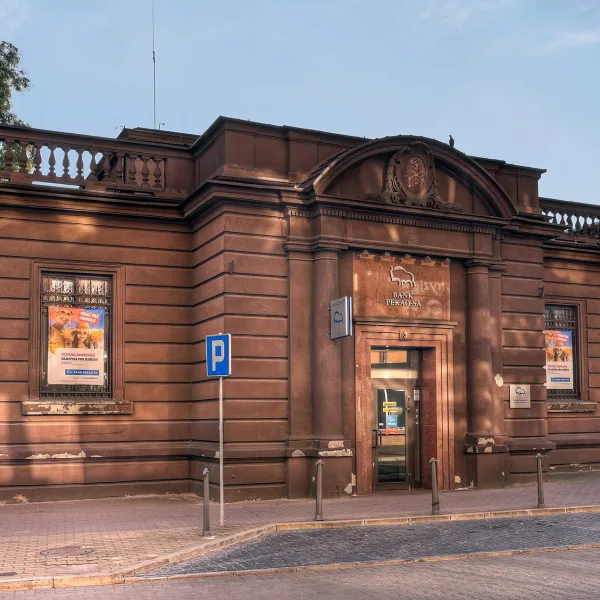
It is worth varying the route with secular buildings. Sosnowiec Główny at 3 Maja 16 is a Neoclassical station of 1859 listed in the register of monuments. The People's House at Klubowa 2 in Kazimierz is a timber house for miners, Zakopane in style, built in 1902-1903. The former Bank Handlowy at Małachowskiego 3 was built in 1908 and extended in 1923; a bank and municipal services work there now.
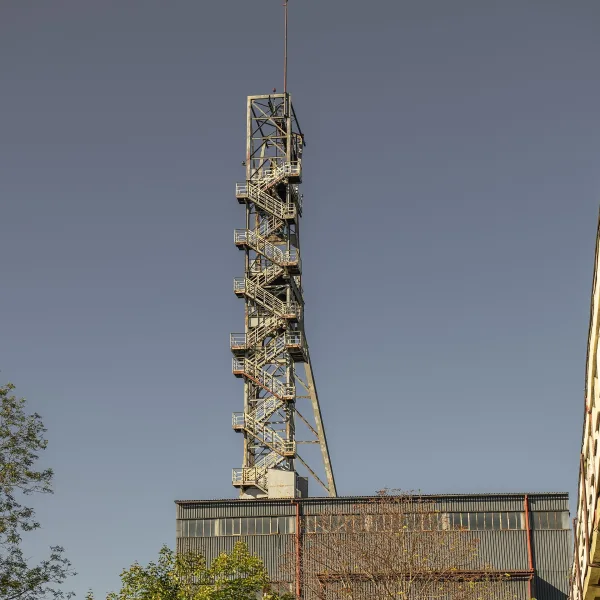
In Porąbka lies the Juliusz Mine Complex at Grenadierów 1B. It was built from 1902, extraction started in 1914, and some of its buildings are on the list of monuments.
How can you link places with neighbouring addresses?
Some sites lie right next to each other. In Środula, Wilhelm's Palace and the museum in the Schön palace both stand on Chemiczna street, so they make one stop. In Pogoń the Dietel Palace (Żeromskiego 2a) is a neighbour of the Lutheran church (Żeromskiego 1A). In the centre only a few steps separate Sosnowiec Główny station (3 Maja 16) from the Church of the Sacred Heart (3 Maja 20), and the Franz Schön Palace is on 1 Maja street. Such sets let you see several places on one short walk.
Where can you cycle in Sosnowiec?
Two cycle trails run entirely through the city. The Zagórski Forest Trail is blue and 5.4 km long, and leads through the districts of Zagórze and Morze Czarne. The Black Sea Cycle Trail is green, 15 km long, and runs from Kuroń Park to the Three Emperors' Corner. The calm character of the routes suits travelling alone. For green areas in the conurbation, read about reserves and green enclaves in the GZM cities.
Frequently asked questions
What is a good first stop for a lone visitor in Sosnowiec?
Begin with Sielecki Castle and the museum in the Schön palace, then go on to the Dietel Palace and the churches in Pogoń.
Is the Franz Schön Palace open for visits?
A district court sits in the building, so it is best admired from the outside.
What can you do in Sosnowiec in bad weather?
You can choose among the museums: the palace one, medicine and pharmacy, earth sciences and the Carmelite sisters', as well as the People's House.
Where can you check the rest of the places in Sosnowiec?
The complete list is at Sosnowiec, and for people without company there is also the Solo section covering the whole region.

 Historic sites