Atmospheric places in Katowice: the Market Square, Mariacka Street, Giszowiec and the Culture Zone. Dozens of addresses for a city walk.
The atmosphere of Katowice comes from modernist housing blocks, mining estates, hexagonal squares and the glass buildings of the Culture Zone. This list gathers the addresses where the character of the city is easiest to feel, usually on foot rather than in a ticket queue.
Where to start looking for atmospheric places in Katowice?
Start in Śródmieście, the city centre: the Market Square, Mariacka Street and Freedom Square lie close together and give a picture of the centre. Then head to Giszowiec, a mining estate with a green square in the middle, and to Koszutka and Bogucice, where the modern buildings of the Culture Zone stand.
Which squares and promenades in the centre are worth seeing?
The Market Square took shape from the 1850s onwards. After a rebuild in 2016 the whole square was reopened. Today tram tracks cross it, a theatre building stands beside it and a bugle call sounds at noon. Among the streets leading off the square is 3 Maja Street, where the Frog fountain waits.
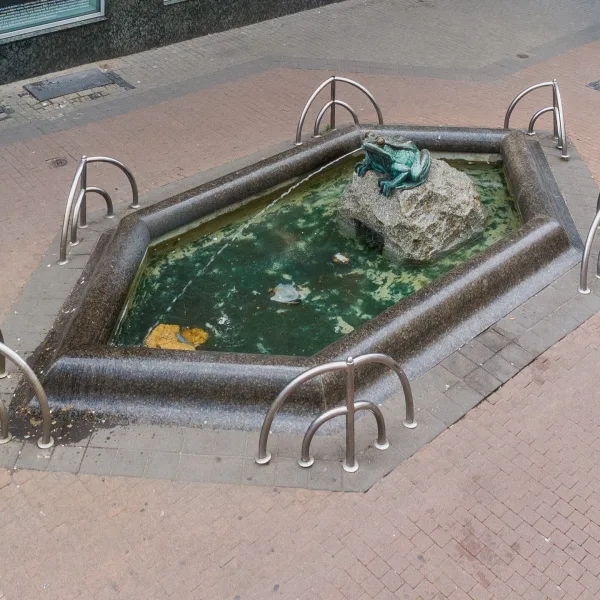
Mariacka Street is a promenade leading to St Mary's Church, from which it takes its name. It has been pedestrian-only since 2008, and its townhouses date from the turn of the twentieth century. The Frog fountain stands at 13 Stawowa Street, at the junction with 3 Maja. The brass frog from 1980, by Joanna Ambroziak-Hanasiewicz, weighs over a hundred kilograms and sits on a granite boulder.
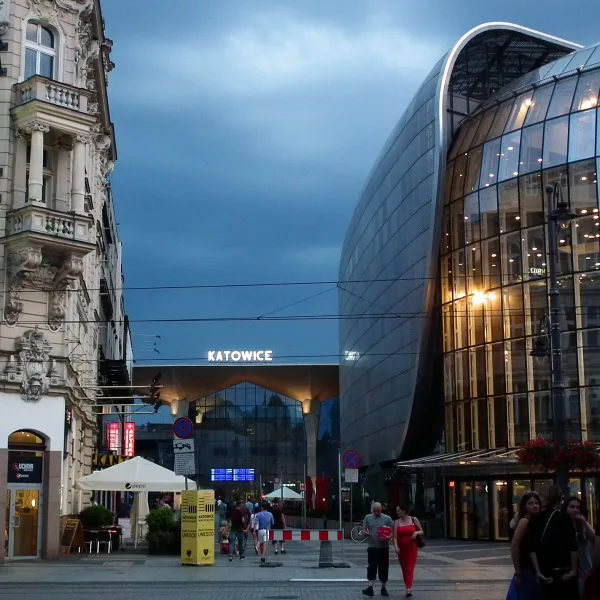
Freedom Square is a hexagon with streets radiating from it: 3 Maja, Sokolska, Gliwicka, Matejki and Sądowa. The layout comes from the city plan of 1856, and the square is ringed by listed townhouses and the Goldstein Palace. The green Karol Miarka Square south of the railway tracks has a Moniuszko monument from 1930 and the Karlik fountain. In front of the station lies Maria and Lech Kaczyński Square, between 3 Maja and Młyńska streets, one of the main interchange points of the city.
Two more squares neighbour each other, linked by Lompy Street. Silesian Parliament Square was set out in the 1920s next to the Silesian Parliament building, with a monument to Wojciech Korfanty at its centre. On Bolesław Chrobry Square the Silesian Museum stood before the war, and today there is an obelisk of the Silesian Eagles and a monument to Józef Piłsudski. The building of the Marshal's Office closes it from the north.
What does modern architecture mean in Katowice?
The strongest modernist accent is the Superjednostka on Korfantego Avenue, built in 1966-1970 as a "Compact Housing Unit". It is 187.5 metres long and has 764 flats, and for some years it was the largest residential block in Poland.
In the Culture Zone the Spodek arena, the Silesian Museum and the home of the radio orchestra stand side by side. They are joined by the International Congress Centre with its green roof, opened in March 2015 on the site of the Katowice colliery, closed in 1999. In Koszutka stand the .KTW office buildings, whose interiors are not open to visitors, although you can see the form and the publicly accessible square from outside, and Rondo Sztuki, an Academy of Fine Arts gallery in a half-dome building from 2007, with exhibitions of graphics, photography and design.
The centre also has the University of Silesia campus, which combines modernist buildings from the 1960s and 1970s with a newer library and the Film School, and Katowice Miasto Ogrodów, a municipal cultural institution at 2 Sejmu Śląskiego Square that runs music and visual festivals.
Which estates and sites show the mining past?
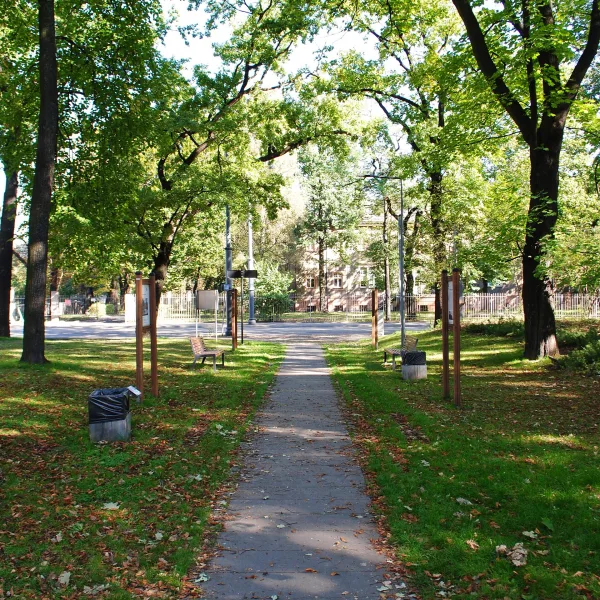
Giszowiec dates from 1907-1910 and was planned as a garden city for miners; roughly a third of the original housing remains. The heart of the estate is Pod Lipami Square, the work of Emil and Georg Zillmann, redone in 2014-2015.
In Wełnowiec-Józefowiec, on the border with Siemianowice Śląskie, lies Alfred Square, important for the complex of the former "Alfred" shaft and the workers' colony that people still live in. Next to it grows Lasek Alfreda, a municipal wood of almost sixteen hectares. In Szopienice the focal point is Silesian Insurgents Square, with the church complex of St Hedwig and an obelisk.
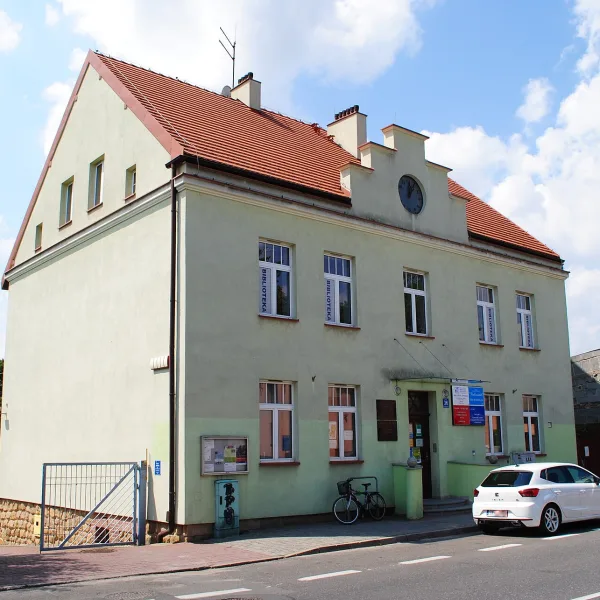
Former village centres show the rural past of the districts. Kasprowicz Square in Murcki was a village market, and today it is surrounded by early twentieth-century modernist buildings and a figure of St Barbara. In Podlesie stands the former municipal office from 1912, with a clock from 1913, which now houses a library and a local heritage room. In Załęże, Father Londzin Square, known as Gruszka, is what remains of the park by the old palace.
Where in Katowice can you find quiet and greenery?
The most woodland character belongs to Dolinka Murckowska on the Przyrwa, where trails pass a pond and a water garden. The area has been a recreation spot since a bison pen was built there in 1865. Hidden in the Gniotek forest in Podlesie, the Gypsy Bridge (Most Cygański) is a disused reinforced-concrete viaduct from around 1918, about ten metres high, built for a planned colliery.
Kościuszko Park holds the Lapidarium, a small open-air display of boundary stones, plaques and gravestones run by the Katowice History Museum. Greenery across the whole city is covered on the page parks and nature in Katowice. On Osiedle Witosa the feel of a neighbourhood belongs to St Herbert Square which has a church, a fountain and a playground.
Which places linked to religion and tradition are in this set?
In Panewniki stands the provincial house of the Servant Sisters, from the 1930s. The building serves as a convent and retreat house, and inside are chapels, a memorial room of Blessed Edmund Bojanowski and a missionary museum. Remember that it is a religious house, not a tourist site, so a visit needs to be arranged.
Also in Panewniki, the Nativity scene in the basilica is built every year, a tradition begun in 1908, and has around a hundred and twenty figures. It is regarded as the largest altar crib of its kind in Europe. Other churches of the city are gathered on the page churches and monasteries in Katowice.
Frequently asked questions
Which places in Katowice have the most atmosphere?
People most often point to Giszowiec with its green mining estate, Mariacka Street, the Market Square and Freedom Square. Fans of modernism choose the Superjednostka and the Culture Zone.
What can you see in Katowice on a one-day walk?
A good plan is the Market Square, Mariacka Street, the Frog fountain, Freedom Square, and Silesian Parliament Square with Bolesław Chrobry Square. All lie in the centre and are linked by 3 Maja, Jagiellońska and Lompy streets.
Is Giszowiec worth a long trip?
Yes, if you are interested in mining estates and architecture. Only part of the old housing remains, yet the layout around Pod Lipami Square is still easy to read.
Can you go inside the .KTW office buildings?
No. Visitors cannot enter the interiors, but the towers and the neighbouring square can be viewed from outside.
Where can you see traces of the old villages?
Former village centres survive in Murcki at Kasprowicz Square, in Podlesie at the former municipal office and in Załęże at Londzin Square.

 Places with character